For many wine lovers, Langhe is synonymous with Barolo, Nebbiolo, and some of the world’s most celebrated red wines. Yet within this internationally renowned region, another story continues to unfold—one centered on the revival of a native white grape variety. Few examples illustrate this better than Nas-cëtta.
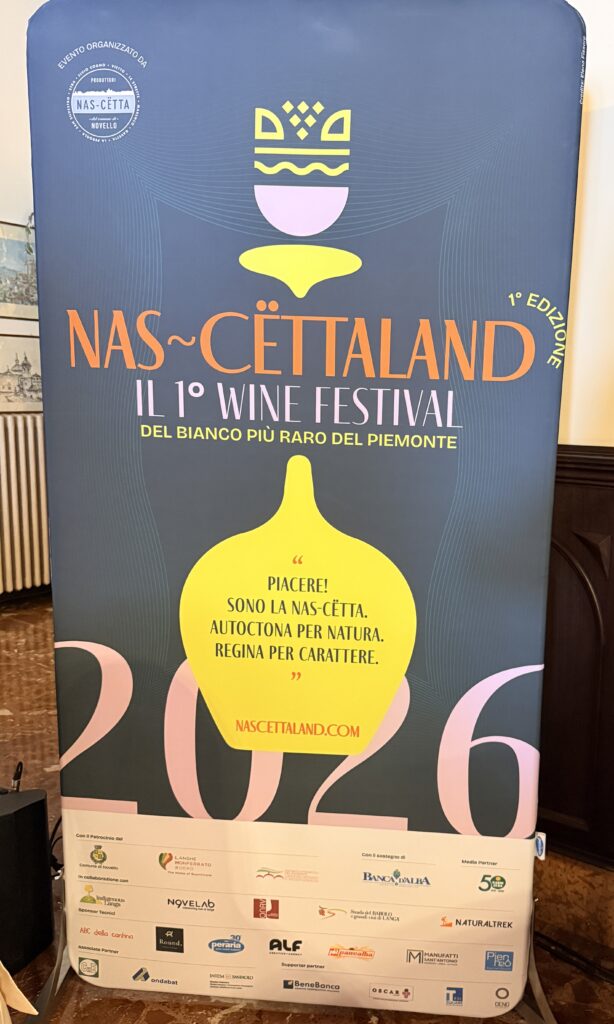
During this year’s Nascettaland, the first edition of a Nas-Cëtta di Novello and Wine Festival, producers, researchers, wine professionals, journalists, and wine enthusiasts gathered in Novello to explore the history of this once-endangered grape and its significance within the contemporary landscape of Langhe wines.
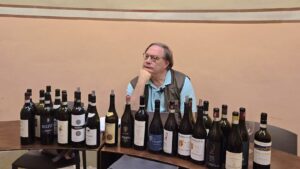
The weekend-long festival featured technical seminars, educational presentations, and extensive tastings; and a ceremony naming our Editor-in-Chief, Ian D’Agata, an ‘Honorary Citizen” of Novello, an admittedly huge, once-in-a-lifetime honour. Through comparative tastings of wines from different producers and vintages, including a walk-around tasting where producers not just of Nascetta di Novello but of Langhe Nascetta as well poured different vintages of their wines, participants gained a deeper understanding of Nas-cëtta’s aromatic profile, terroir expression, and aging potential. From vibrant citrus and white floral notes to riper fruit aromas, mineral nuances, and increasingly complex tertiary characteristics of diesel fuel and almond in various forms, the grape continues to reveal a depth and versatility that challenge many traditional assumptions about white wines from the region.

More than the wines themselves, however, what stood out most throughout the event was the remarkable sense of unity displayed by the community. The survival of Nas-cëtta is not the achievement of a single winery, but rather the result of decades of collective effort. At a time when few people showed interest in the variety, a small group of growers in Novello, led by Elvio Cogno and the Fratelli Daniele of the Le Strette winery, chose to preserve old vines and continue cultivating and vinifying the grape. As the years passed, more producers throughout the Langhe began to recognize its value and joined the effort to restore and promote it.
This year’s festival brought together a broad range of wineries actively involved in the Nas-cëtta project, including all fifteen producers of Nascetta di Novello (including Elvio Cogno, Cascina Gavetta, Le Strette, Cogli L’Attimo, Stra, Vietto, Merenda Sinoira, Roberta Valletti, Mauro Marengo, Luca Marenco, Casa Baricalino, San Silvestro, Arnaldo Rivera, La Pergola and Massimiliano Passone), but also Poderi Cellario, Diego Morra, Bel Colle, Cascina Gentile, Marco Capra, Serio e Battista Borgogno, Rivetto, Castello di Perno, Abbona, Ravera, Stroppiana, and numerous other producers from neighboring areas. Together, these wineries showcased not only the stylistic diversity of Nas-cëtta, but also the region’s long-term commitment to protecting and promoting its native grape heritage.

Among the participants, Elvio Cogno remains one of the most influential names in the modern revival of Nas-cëtta. For many years, Valter Fissore and Nadia Cogno have been among the grape’s most dedicated advocates. At a time when Nas-cëtta received little commercial attention, they continued to invest in research, vineyard work, and winemaking, convinced of the variety’s untapped potential. Their wine, Anas-Cëtta, became an important reference point for consumers and professionals alike, helping to bring the grape back into both critical and international discussions.
Yet perhaps even more meaningful than the wine itself is the way this commitment is now being passed on to the next generation. During the festival, visitors witnessed not only the dedication but also the active involvement of younger family members, including Elvio’s granddaughter Elena and her husband Giulio Giacosa. The festival itself was conceived by Elena Fissore Cogno, but its realization was the result of a shared effort involving many members of the Novello community, most notably President Luciana Passone and Vice President Roberta Valletti, whose dedication and hard work were instrumental in bringing the event to life.
More importantly, the festival highlighted the collective enthusiasm of a community determined to safeguard and promote its native grape heritage, reflecting the shared commitment that has made the revival of Nas-cëtta possible.

Indeed, the growing participation of younger winemakers is among the most encouraging developments surrounding Nas-cëtta today. Many young estate owners and successors increasingly view the grape as an authentic expression of local identity. While respecting tradition, they are also exploring new approaches to viticulture, winemaking, and communication, ensuring that Nas-cëtta remains relevant to contemporary consumers without losing its roots. For the Langhe, the revival of Nas-cëtta is far more than the return of a forgotten grape to the marketplace. It reflects a region’s respect for its cultural heritage and demonstrates a level of collaboration among producers that has become increasingly rare in today’s wine world. At a time when globalization and varietal homogenization continue to reshape the industry, Nas-cëtta serves as a reminder that local identity and native traditions remain among a region’s most valuable assets.
As one of the final messages displayed throughout the festival stated: “Nas-cëtta is more than a wine. It is a shared choice.” Those words encapsulate the essence of what has taken place in Novello over the past several decades. From the determination of a handful of growers to the participation of an entire community; from an almost forgotten grape variety to one of Langhe’s most distinctive native white wines, the story of Nas-cëtta demonstrates that a region’s greatest strength often lies in its willingness to protect its own history and traditions. Today, as more producers and younger generations continue to join the movement, this grape variety—once saved by a few—is increasingly being embraced by many.

Perhaps the true significance of Nas-cëtta lies not only in the wines it produces, but in what it represents: proof that when a community chooses to safeguard its past, even those things that once seemed destined to disappear can still have a future.