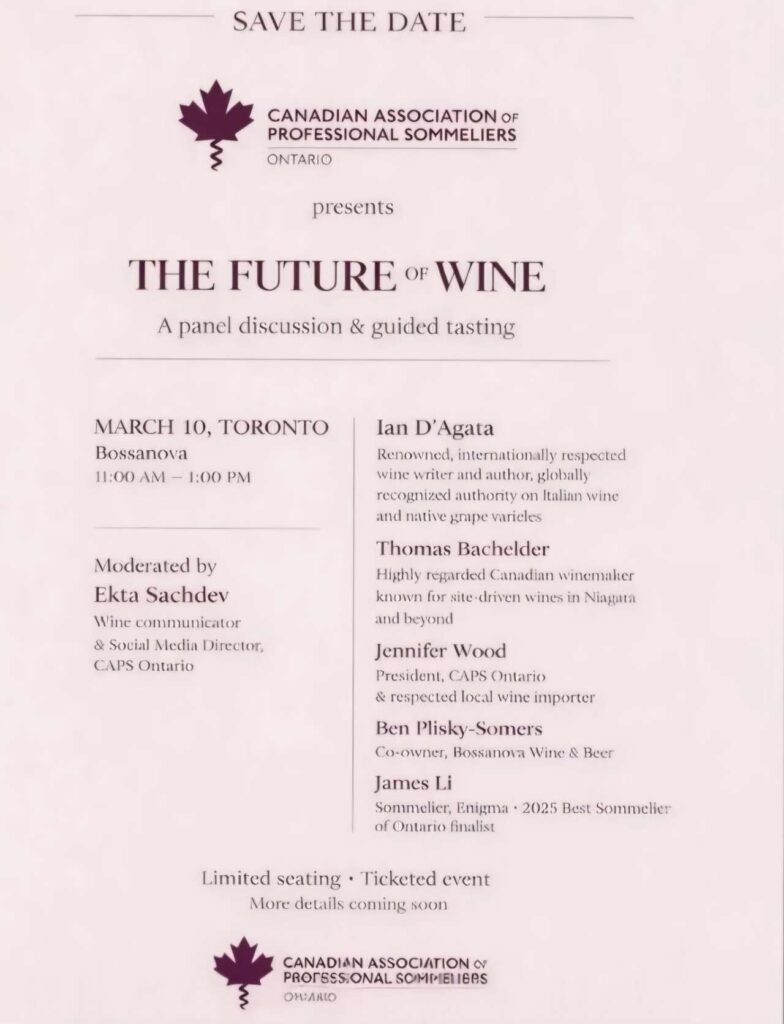
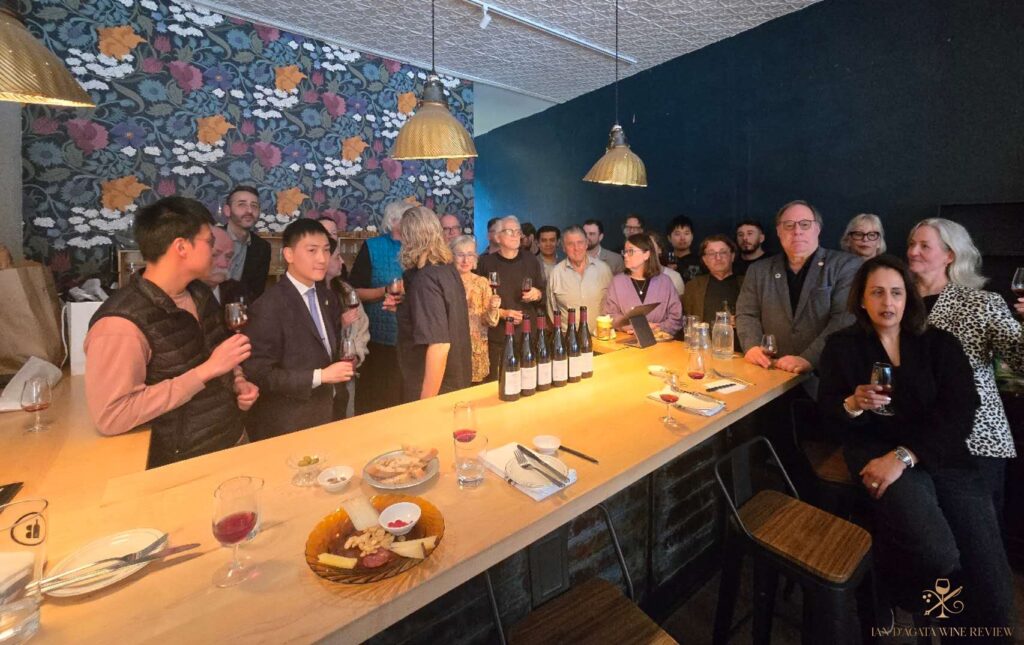
On March 10, the “Future of Wine” conference organized by CAPS (Canadian Association of Professional Sommeliers), broached uncomfortable but very current issues facing the wine industry at a time of generalized difficulty for wine, in terms of its image among younger people and market sales. Keynote speakers included our Ian D’Agata, some of the best-known sommeliers and educators in Toronto including Ben Plisky-Somers and James Li, as well as the President of CAPS Ontario and respected local wine importer Jennifer Wood. One of the best Canadian wine producers, Tom Bachelder, also intervened and guided a wine tasting based on the importance of terroir showcasing terroir by way of six of his very different Pinot Noir wines. The meeting, which sold out quickly, was led and moderated by Ekta Sadchev, Social Media Director of CAPS Ontario.
The topics addressed at the conference by the experts, local and international, were varied: Has consumer behaviour fundamentally shifted in the past five years, or are we experiencing a temporary recalibration driven by economic pressure? Where in the ecosystem are these shifts most visible, and how are they influencing portfolio construction, wine lists, and retail strategy? How is climate change reshaping not just style, but geography and long-term investment decisions? Where are pricing pressures being felt most acutely today? Is the mid tier economically sustainable in 2026? How do we distinguish authenticity as practice rather than positioning? Has the authority of traditional gatekeepers weakened, and if so, what has replaced it? Does wine still hold cultural power in 2026, or is it becoming increasingly niche?
Overall, numerous key take-home messages were delivered during the course of alively and spirited conversation between panelists and speakers and the public of wine professionals attending the conference. Clearly, a generally held opinion was that there is a real need to engage the wine lover more in dining establishments, rather than going through the minimum motions. For example, bringing the bottles of the “wines by the glass” choices to the table, rather than just two glasses of wines and nothing else, is of paramount importance to allow the somm and his clients to engage and talk more about the wines with the client; by showing them the labels, it also helps clients fix in their memory the wines they drank and enjoyed on the night, a recollection that is vital when the time comes to buy more wine. This simple act was generally cited as being a real difference-maker for most restaurant programs. Clearly, many cited the need to offer more cost-effective wines, given that some wine lists have nothing that is less than $CDN 100, a price tag that is simply to steep for many of today’s incomes. Ad to drink really well $CDN 250-300 has become almost a new-normal, which is detrimental to the wine cause on so many different levels one wouldn’t even know where to start in listing them all.
Others mentioned that there is a pressing need to increase the availability of truly meaningful wine education, not just spot messages on social media that are often inexact and self-serving, if not downright sponsored by wine companies or government entities with an agenda to follow. The general consensus is that we are living in a new era of communication, one in which we communicate not just differently in context but in the content, and as such, what and how we communicate wine, or how wine is communicated, needs to be addressed, if not downright confronted. For example, when government institutions post about would-be outstanding tastings where very dubious wines are obviously part of the program, that needs to start getting pointed out, because otherwise we are all at the mercy of what amounts to fake news. And the bottom line is that people aren’t stupid: you can fool them once, but once they do get taken for a ride having been served wines such as many Montepulciano d’Abruzzo wines that are tough, angular and fruit-challenged, or jammy, sweet coffee and cocoa-rich reds from South America or Australia that taste all the same and have little connection to the grape variety they are supposedly made with and that are not exemplary in their food-pairing capacity, we tend to lose such wine customers for good. Wine is simply too expensive today for people to be served crap and expect them to keep buying. Clearly, we are not talking here of excellent wines such as those by Catena, Bass Philips, Rockford, or Valentini.
At the same time, the need to return to our roots and listen to only that dozen or so of true wine experts writing and talking about wine is also of cardinal importance: there are far too many people nowadays talking, writing and generally hyping up the wines of regions to which they have been invited to on all-expense paid trips in which hotels, flight s and meals are all taken care of by whoever is doing the inviting. And do you really expect people who accept such invitations to then diss the wines? Clearly, that’s not likely, and so we get a litany of 95+ scored cheap entry level whites and reds that are anything but memorable and that, once again, will turn off people from wine completely. Rather than listen to a would-be expert, people today are better off listening to wine-loving friends with similar tastes and in that way avoid being bamboozled by those who have vested interests, or who, in many cases, simply don’t really know enough. The internet and social media are wonderful tools of democratic communication, but the general conclusion is that we need to turn them into two way streets rather than the one way street of pushing all wines as stellar that these communicative forms have become, and in so doing add very little of use to people’s wine knowledge, culture and enjoyment. Rather, we need to start turning them into useful learning tools, and those who try and pull fast ones need to be singled out and exposed.
Some in the audience pointed out the problem of wine and the industry not receiving the government help of other industries, such as in the forms of subsidies but also, on a much more simpler level, a more positive spin on the product. Examples were given of countries were governments actively discourage wine consumption, a nonsensical approach given how much other alcohol-containing beverages, other substances and even highly processed, fat-filled foods that are being consumed on a daily basis. Clearly, nobody wishes to endorse over-drinking (if there is a potential problem with wine, it is most certainly not moderate daily intake but excessive intake), but painting wine as a generically bad entity best avoided at all costs is neither accurate nor historically acceptable (the example of a French TV commercial showing a dinner table with a bottle of wine on it and the bad message it was sending the family’s kids was given as an example of how government-sponsored commercials try to dissuade people from drinking wine). Forwarding such messages borders on bad faith and vested interests, because it is simply unacceptable in this day and age that wine gets singled out but that the consumption of highly-processed artificial foods, excessive use of social media and the sedentary life that goes with it are not, or at the very least, not to the same extent. Why is that discouraging eating at McDonald’s, Burger King and similar fast food chains is not routinely addressed? Regular intake of such foods has been clearly linked to long-term health risks such as heart disease, high blood pressure, obesity, diabetes, and even some forms of cancer. No health benefit of any kind has ever been demonstrated by daily consumption of highly-processed, high-sugar and high-fat containing foods, while there are a slew of well-done medical papers that clearly have indicated a potential health benefit to consuming wine in small, moderate quantities. And yet, this obvious, very real and factual dichotomy is ever addressed as such. Why? Does it have to do with the economic and political clout of companies associated with the industrial production of food that is simply not good for us? Well… considering how important wine is to local economies, how many people the wine industry employs, nd how many families work directly or indirectly with wine, to bluntly and generically condemn wine’s consumption seems narrow-minded, to be charitable. And perhaps the time is nearing when wine producers all over the world, rather than meekly accepting things as they are today need to bandy together and make their collective voices heard.
Last but not least, if wine is to have a future, the authenticity of it also needs to be ensured and protected: wine is a marvelous beverage because of its traditional importance, cultural value, and the fact that unlike soft drinks speaks specifically of a place and a grape variety, the local viticulture and winemaking. A Sangiovese or a Merlot or a Tempranillo wine made in different parts of the world should not always taste the same and be indistinguishable one from the other: when that happens, then wine and those who produce it abdicate from wine’s role of being a translator of terroir and a messanger of biodiversity, traits that are part of wine’s immense appeal. The conference concluded on a bright note, with one of the group’s goals being to increase the number of such encounters and conferences and to schedule them at regular intervals during the year.
Congratulations to all the participants and the organizers on an extremely interesting, useful morning’s encounter and a job well done!