
Between Rosé and Red: Rethinking Cerasuolo d’Abruzzo, as It Always was and Should Be

by Yumi Liu

The international perception of rosé wine has, by now, become almost formulaic.

The paler the colour, the better. The lighter the body, the more desirable. Ideally, the wine should offer vague (very vague: and inoffensive is even better) aromas of strawberry, fresh citrus and white flowers, and be designed for easy drinking by the seaside, at the pool, or on a warm summer afternoon. Over the last two decades, Provence-style rosé has completely reshaped the global imagination of what pink wine is supposed to be.

But Cerasuolo d’Abruzzo has never belonged to that world. At least, traditional Cerasuolo, the way it always was and should be, has not.
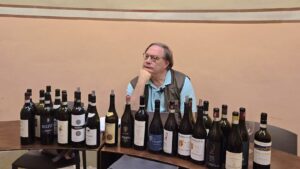
Cerasuolo d’Abruzzo is a wine made with the Montepulciano grape in the region of, you guessed it, Abruzzo. This beautiful Italian region is about 85% designated to parkland of one kind or another (national, regional, provincial, mountain, local oasis) and lies like a jewel between the Apennine mountain range to the west and the Adriatic Sea coastline to the east. Its Cerasuolo wine (not to be confused with Sicily’s Cerasuolo di Vittoria, a red wine made with the Nero d’Avola and Frappato grapes) is typically more of a pale red wine than any pink wine you can think of. Cerasuolo d’Abruzzo is deeper in colour, broader in structure, and far more tactile and fruit-driven than any modern Rosato/Rosé/Blush wines. In fact, that is the historical heart and soul of Cerasuolo d’Abruzzo: it has always been much more remarkably close to a complex light to medium-dark red wine rather than a simple pink one. The very word that gives it its name, cerasuolo, refers to cerasa, a type of red colour associated with fairly deeply hued red cherries. But the best examples of Cerasuolo d’Abruzzo are never just red wine wannabees: they are highly gastronomic and food-friendly, age-worthy, and in the best vintages achieve a fascinating balance somewhere between red wine depth and rosé freshness. It is, in other words, much more than a simple sum of its parts.

Perhaps because of this, truly great Cerasuolo has always resisted easy categorization. But that does not mean it should be allowed to turn it into a travesty of what it always was, and still should be.

To be charitable, Abruzzo is witnessing increasingly diverse interpretations of the Cerasuolo d’Abruzzo style. Some such interpretations are part of a understandable desire to push boundaries and explore possibilities: there are talented, passionate producers who focus on texture and structure; others emphasize acidity and minerality; while a few are pushing the traditional idea of deep-coloured, table-oriented Cerasuolo wines further than it ever has been before. Clearly, all that is just fine and dandy: you grasp the idea at the core of the product, you comprehend the sense to those trials, maybe even admire the daring aspiration behind the quest. But what one cannot forgive, what one cannot explain, and what one cannot and should not accept, is the many paler than pale “Cearsuolo d’Abruzzo” wines that are trying to out-Provence a bad Provence Rosé: soulless wines of no colour, no perfume, no mouthfeel. Such Cerasuolo d’Abruzzo wines are pathetic attempts at reproducing a fad, of cashing in on a fashion, on gaining market shares of something that is here today and will, like all fashions, be most likely gone tomorrow. Wines of no past and no future, that exist in a vacuum and that betray everything Cerasuolo d’Abruzzo has always been. Wines that any country serious in defending its traditions, its history, it reason for existence even, would not allow: after all, if you want to make a pale pink wine, fine, it’s a free world, go ahead. But label them “Rosato”, a category that the Abruzzo guidelines contemplate and cover. Or perhaps “Rosa”, in honour and memory of poor Luigi Cataldi Madonna, one of the region’s best producers who sadly passed away years ago and who made not one but two outstanding Cerasuolo d’Abruzzo wines and was a huge proponent of creating a regional lighter-coloured pink wine category. In any case, separating the wheat from the chaff, there are many outstanding Cerasuolo d’Abruzzo wines still being made today. It. Is producers such as these that deserve your support and encouragement. Better still, your money. After all, behind these wines are families whose livelihood depends on wine sales.

As previously mentioned, Cerasuolo d’Abruzzo can and should be open to different interpretations. There are many good directions it can be taken in, provided one doesn’t stray too far off the beaten path, and in so doing run the risk of reducing it to a caricature of somebody else’s French wine. Barone Cornacchia, Praesidium, Tiberio, Valle Reale and Valentini represent five very different, yet equally compelling, such intepretations. Five directions to choose from, and five arrival points with lots to tell, enriching us all.

Forget the rest and stick with the best.

Five Cerasuolo d’Abruzzo, five interpretations and directions

Barone Cornacchia: Returning to the Traditional Depth and Structure of Cerasuolo d’Abruzzo

If many contemporary Rosati wines continue to move towards even lighter, softer and increasingly international styles, Barone Cornacchia’s Cerasuolo d’Abruzzo Poggio Varano moves decisively in the opposite direction, as it should. This Cerasuolo, produced in the clay-rich Colline Teramane from 100% Montepulciano and fermented and aged in amphora, does not attempt to conform to modern expectations of Rosé. Instead, it seems to reaffirm a simple idea: Cerasuolo d’Abruzzo was never meant to be, and never was, just another pink wine. Its deep cerasa/cherry hue immediately sets it apart from many contemporary Rosé wines. Rather than focusing on lightness and immediacy, Poggio Varano prioritizes structure and gastronomic character. This tastes less like an aperitif wine and more like something destined for the table- naturally pairing with tomato-based dishes, roasted poultry, lamb, mushrooms and even richer seafood preparations. In many ways, it behaves more like a lighter-coloured Montepulciano than a conventional Rosato. And that is precisely what makes it so compelling.

Praesidium: Where tradition rules

The Praesidium estate is a relatively young wine, founded only in 1988 by Enzo and Lucia Pasquale and is run today by their children Ottaviano and Antonia. They farm about five hectares on the western side of the Valle Peligna hills at about 400-500 meters above sea level. Day-night temperature excursions are extreme here, so all of Praesidium’s wines are characterized by crisp steely fruit and depth of perfume, not to mention vibrant acidity. Wines are made with minimal intervention, from organic-certified grapes, with natural yeasts only used. Praesidium makes some of Abruzzo’s most traditional, historically faithful wines: if you want to get an idea of what Abruzzo’s wines might have been like one hundred years agoor so, with caveats, this is a good place to start. When not marred by funky notes that the majority of the world’s wine drinkers do not like, theirs have always been and are amongst Abruzzo’s best wines; unfortunately, the wine are not easily found by wine lovers and wine professionals, given the small volumes made.

Tiberio: Precision, Linearity and a Mineral-Driven Modern Cerasuolo

Compared with Valle Reale, Tiberio maintains a far more sharply defined stylistic identity. Over the past years, siblings Antonio and Cristiana Tiberio have emerged as two of Abruzzo’s and Italy’s most important figures, with a philosophy firmly centered on purity and precision. That philosophy is clearly reflected in their Cerasuolo. Tiberio’s wines typically display a vivid, transparent pink-fuchsia colour alongside exceptionally pure aromas of red cherry, strawberry and delicate flowers. But unlike many texture-driven interpretations of Cerasuolo, Tiberio focuses instead on linearity, bright acidity, mineral tension and overall transparency. These qualities become even more pronounced in vintages such as 2024 and 2025.

In a previous Abruzzo annual new vintages report, Ian D’Agata described the 2024 Tiberio Cerasuolo as one of the estate’s finest recent releases, while also highlighting the brilliance of the 2022 vintage. I fully agree. Both vintages showed extraordinary precision, vibrant acidity and exceptionally clean structure, effectively defining the classic Tiberio style. Yet 2025 feels like a further evolution of that already highly precise expression under outstanding vintage conditions. The wine retains Tiberio’s hallmark freshness and tension, but appears more open than either 2022 or 2024, revealing broader fruit layers and greater textural depth. Although never heavy, it maintains a focused, crystalline and elongated structure throughout. Compared with the broader and more generous expression of Valle Reale, Tiberio feels more restrained, more linear, and more clearly driven by minerality and purity. In many ways, 2025 does not represent a stylistic departure for Tiberio, but rather a more complete and mature expression of its precision-driven identity.

Valle Reale: Mountain Freshness and a Broader Expression of Fruit

If Barone Cornacchia emphasizes tradition and texture, Valle Reale remains firmly rooted in mountain terroir and freshness. Owner Leonardo Pizzolo established Valle Reale in one of the coolest parts of Abruzzo, the Valle Peligna where the Montepulciano grape was born, focusing on high-altitude vineyards shaped by the dramatic diurnal shifts created by the Gran Sasso massif. These conditions consistently bring tension, freshness and balance to the wines. International critics have long regarded Valle Reale as one of Abruzzo’s most serious and terroir-driven producers. Compared with many Montepulciano estates that pursue extraction and power, Valle Reale places far greater emphasis on altitude, freshness, transparency of terroir and a refined, almost mountain-wine character. That philosophy extends naturally into their Cerasuolo, an especially captivating wine. Rather than simply expressing cool-climate restraint, it combines bright acidity with a far more generous and expansive fruit profile. The wine possesses greater presence and breadth on the palate than expected yet never sacrifices the balance and freshness that define the estate’s style. This vintage retains Valle Reale’s mountain tension, but introduces a more evident sense of fruit generosity. It may not be the most austere interpretation of Cerasuolo, but it is remarkably complete and deeply drinkable.

Valentini: where legend meets quality

What can reasonably be added to the mystique, the fame, the lore that is Valentini? Simply one of Italy’s ten most famous and best wineries, the estate makes three wines only and each can be taken as a benchmark of its category. The Trebbiano d’Abruzzo dukes it out with the Pinot Bianco of Terlano as Italy’s longest-lived white wine. The Montepulciano d’Abruzzo can be better than almost all of the Barolo, Barbaresco, Amarone and Bolgheri wines you can think of and ranks with the world’s greatest wines of all. And the Cerasuolo d’Abruzzo, that some might argue is this winery’s weakest wine (“weakest” in relative, very tongue-in-cheek terms, as it still is really grand stuff), is a wine that straddles the boundary separating white and red wine like nothing else in Italy.

Valentini is a noble family of Spanish origin that has been living in Loreto Aprutino and the Palazzo Valentini since 1600.The estate is now run by Francesco Paolo, son of Edoardo, along with his wife Elena and son Gabriele. They also follow the other agricultural products of the vast estate (for instance, the Valentinis produce outstanding grains for pasta production and make what is unquestionably one of the three-five best Extra Virgin Olive Oils of any winery in Italy). Their Cerasuolo d’Abruzzo is just as remarkable, easily the most elegant Cerasuolo wine of Abruzzo, with an intense underlying minerality to its small red fruit aromas and flavours that is quite unlike that of any other.

Final considerations…

Barone Cornacchia, Praesidium, Tiberio, Valle Reale and Valentini ultimately represent five distinct directions for modern Cerasuolo d’Abruzzo. Examples of how you can intelligently reinvent something pushing the envelope but without destroying its identity, its raison d’être. Barone Cornacchia leans towards traditional, amphora-driven structure; Praesidium offers a taste of the mountain and the most traditional of Cerasuolo wines; Valle Reale expresses mountain freshness and broader fruit generosity; Valentini showcases the noble, refined side oif Cearsuolo d’Abruzzo; and Tiberio pushes further towards precision, linearity and mineral purity.

Yet they all share one important quality: None of them attempt to become yet another international-style rosé. Instead, each preserves the singular identity of Cerasuolo d’Abruzzo, a wine that exists somewhere between Rosato and light Rosso, while retaining structure, terroir expression and genuine gastronomic character. And that is precisely what makes Cerasuolo d’Abruzzo truly fascinating, and unique. In the words of Ian D’Agata, who you will admit, knows a thing or two about Italian wine, “Cerasuolo d’Abruzzo deserves to be its own wine, what it has always been and should be: it is not, and neither deserves, to be a figment of some other pink wine’s imagination.”

The wines in this tasting report

All the wines in this report were tasted in Italy.

Membership Required

You must be a member to access this content.

View Membership Levels

Already a member? Log in here
Share the Post:
Yumi Liu

Yumi Liu has been collecting and drinking wine for more than a decade and has earned a slew of wine certificates in the interim: level 3 WSET and now planning diploma studies; Educator level in Spanish wines (Wines of Spain certified), top level New Zeland wines (Wines of New Zeland certified) and obtained the highest score in her class for German wines (Wines of Germany certified). She has passed all of Ian D’Agata’s Italian wine courses and is generally regarded as being one of the most knowledgeable people on Italian wine in all of China. Over the years, she has also served as the Wine Educator at EMW wines, one of China’s five largest and most important fine wine importers and has led masterclasses on wines at prestigious wine shows including the Wine to Asia fair in Shenzhen and Vinitaly in Verona.

Related Posts

icon

ABOUT THE IAN D’AGATA WINE ACADEMY AND ITS COURSES

Ian’s background in wine teaching and course creation Ian D’Agata has led different wine schools over the years, and has been increasingly asked over the years to set up new ones for different outfits. In the early 2000s, he taught wine courses at the Gambero Rosso’s Citta’ del Gusto, and...

No comments yet.


Show winery reviews

  • Barone Cornacchia
  • Praesidium
  • Tiberio
  • Valentini
  • Valle Reale
