Bordeaux dry whites are easily reduced to a familiar formula: Sauvignon Blanc supplies freshness and aromatic lift; Sémillon brings body, texture and ageworthiness; Sauvignon Gris or Muscadelle may occasionally add another layer of complexity.
Useful as that shorthand may be, it quickly ceases to explain what is in the glass when nine dry whites, from different places and vintages ranging from 2017 to 2023, are tasted together, because each winery sues its own belnd and approach to white winemaking.
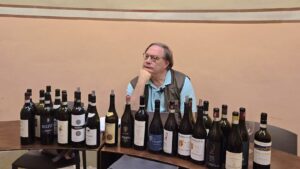
There is a 100% Sauvignon Blanc, as well as several different Sauvignon Blanc–Sémillon blends. Aile d’Argent 2022 draws on four varieties, while Palmer steps entirely outside the modern Sauvignon Blanc–Sémillon paradigm, using Muscadelle, Lauzet and Sauvignon Gris to revive an almost forgotten chapter in the history of Médoc white wine.
Vintage, too, continually changes the questions an estate must answer. Cos d’Estournel Blanc 2017 has entered its bottle-aged phase; the two Pessac-Léognan wines from 2020 show different philosophies of élevage in the same ripe year; 2021 appears in the Médoc, Margaux and Sauternes; and in the hot, dry, precocious 2022 vintage, the challenge was no longer obtaining ripeness but preserving freshness through a very rapid maturation cycle.
It is always revealing to see what an estate did in a particular parcel and a particular year: when it harvested, which lots it retained, how it shaped the final blend, and how vinification and élevage gave the wine its finished structure. Then if Bordeaux is selling itself short by relying too much on Sauvignon Blanc, a variety grown everywhere in the world, instead of Semillon (a variety with which Bordeaux has very few competitors) is another kettle of fish entirely and an important question that needs to be addressed in other articles, forums and venues.

Appellation: a legal framework, not simply a place
Before turning to the wines, it is worth clarifying what an Appellation is. An appellation is not merely a geographical name; it is a legal framework governing wine categories, permitted varieties and production rules. An estate’s location does not automatically determine the appellation its white wine may use. Its legal identity depends on whether the wine meets the relevant appellation’s regulations.
Saint-Estèphe, Pauillac, Margaux and Saint-Émilion are all clearly defined places, but their appellations are framed around red wine and do not include dry whites. Cos d’Estournel may be in Saint-Estèphe, Aile d’Argent is a white wine made by Château Mouton Rothschild in Pauillac, Château Margaux in Margaux and Le Petit Cheval Blanc in Saint-Émilion; their white wines cannot therefore carry those respective appellations.
Pessac-Léognan is different: its appellation includes dry white wine, so Château Pape Clément Blanc and Domaine de Chevalier Blanc can be bottled as Pessac-Léognan. Sauternes represents another case again. Its appellation is legally defined around sweet white wine, which is why Château d’Yquem’s dry Y cannot be released as Sauternes AOC.
From Saint-Estèphe to Pauillac: what vintage changes
At the northern end of the map is Cos d’Estournel Blanc 2017. The wine is a blend of 80% Sauvignon Blanc and 20% Sémillon. Maturation came early in 2017, but Sauvignon Blanc still benefited from cooler periods during the growing season, retaining good freshness and aromatic definition.
Nearly a decade on, the more interesting question is no longer whether the young Sauvignon Blanc character was sufficiently vivid, but what time has done to it. Primary fruit has receded; riper fruit, hay and more developed bottle-age nuances have emerged. Whether the wine’s acidity and overall structure still support the palate now matters more than the original aromatic intensity. This is why the mere presence of 20% Sémillon cannot explain the wine’s current state. Sémillon can add texture and ageing potential, but the way a dry white develops ultimately also depends on maturity at harvest, acidity, fruit concentration and the structure shaped through élevage.
Moving south along the Gironde estuary into Pauillac, Aile d’Argent 2022 takes the discussion back to the vineyard. The year was exceptionally dry from the outset and marked by repeated heat events through the growing season. Maturity came early, and the white grapes were harvested between August 22 and 31. The final blend was 52% Sauvignon Blanc, 39% Sémillon, 8% Sauvignon Gris and 1% Muscadelle. This was not a vintage short of ripeness. The real question was whether the wine could retain freshness, aromatic clarity and structure once the grapes had ripened so quickly. Each of the four varieties naturally contributes something different, but a simple division of roles—Sauvignon Blanc for acidity, Sémillon for body, Muscadelle for aroma—does not explain 2022. How the vines coped with drought, the pace of ripening in each parcel and the decision to pick on a specific day mattered at least as much as the final percentages. One could say that the blend is a response, not a recipe. The composition of Aile d’Argent 2022 is the result left by a particular vintage. Judged by the wine’s final balance, it is an effective response.

South through the Médoc: from blend to selection
Château La Tour Carnet Blanc 2021 first illustrates the distinction between an estate’s location and its appellation. The property is in Haut-Médoc, but this white wine is bottled as Bordeaux Blanc. The 2021 is a 50/50 Sauvignon Blanc–Sémillon blend. The fruit comes from clay-limestone parcels, harvested separately and at cool temperatures. Fifty percent Sémillon might lead one to expect a broad, oily white, but the reality is more complex. The ripening conditions of 2021 were entirely different from those of the hot, dry 2022 vintage, and a high proportion of Sémillon does not automatically produce the same texture. A blend only becomes meaningful when read in the context of vintage and harvest timing, and age but with a young wine, that’s not the point here. In Margaux, Pavillon Blanc Second Vin 2023 moves the discussion from blending to selection. Like Pavillon Blanc du Château Margaux, it is made entirely from Sauvignon Blanc. Château Margaux formally introduced this second wine with the 2022 vintage; the wine is aged for around eight months, about 20% of it in new French oak. The hierarchy between the grand vin and the second wine cannot therefore be explained by grape variety. Parcels are harvested and vinified separately; maturity, aromatic precision, texture and structure determine a wine’s final destination. This is one of the most interesting aspects of Château Margaux’s white-wine programme: even with Sauvignon Blanc alone, parcels, picking windows, selection and élevage can establish a clear hierarchy.
Vin Blanc de Palmer 2021, also from Margaux, moves in an entirely different direction. It is made from Muscadelle, Lauzet and Sauvignon Gris, with neither Sauvignon Blanc nor Sémillon. This is not an attempt to create an eccentric Bordeaux Blanc. At the beginning of the twentieth century, a number of Médoc châteaux made tiny quantities of white wine for their owners’ private consumption, and Palmer was one of them. The practice was later abandoned. In the late 1990s, however, two long-lost bottles of Vin Blanc de Palmer 1925 were rediscovered, prompting the estate to revisit the Médoc’s historical white varieties. Muscadelle, Sauvignon Gris and the now exceptionally rare Lauzet were replanted in the early 21st century, and Vin Blanc de Palmer reappeared with the 2007 vintage. What is most compelling about Palmer, then, is not simply that it has “no Sauvignon Blanc”, although that is certainly part of its uniqueness and appeal. It reopens a historical window: before Sauvignon Blanc and Sémillon became the dominant language of modern Bordeaux dry white wine, the Médoc had other possibilities.

Pessac-Léognan: the same 2020, two expressions
Further south, in Pessac-Léognan, Château Pape Clément Blanc 2020 and Domaine de Chevalier Blanc 2020 form one of the most useful comparisons in this group. The appellation is the same, as is the vintage, but the styles are markedly different. Pape Clément Blanc 2020 is 62% Sauvignon Blanc, 33% Sémillon, 4% Sauvignon Gris and 1% Muscadelle. Domaine de Chevalier Blanc 2020 is 75% Sauvignon Blanc and 25% Sémillon. Taken alone, 62% and 75% tell us little. The real difference lies in élevage and in each estate’s handling of ripeness. Pape Clément is more open and expansive, with a more palpable textural contribution from lees and wood. Domaine de Chevalier also uses barrel fermentation and extended lees ageing—around eighteen months of élevage, with roughly one-third new oak—but its approach is more focused on restraint, structure and integration. Barrel fermentation, lees contact, bâtonnage, vessel size and time in élevage are not merely ways of adding “oak flavour” to whites such as these. They alter volume and texture, the wine’s redox environment, and the way acidity and alcohol are ultimately perceived. In a ripe year, the real difference is often not which wine is richer, but whether ripeness becomes weight or is transformed into tension.
From the Left Bank to the Right: Sauvignon Blanc need not taste too much like Sauvignon Blanc
Across on the Right Bank is Le Petit Cheval Blanc 2019. The wine is 79% Sauvignon Blanc and 21% Sémillon, harvested from September 3 to 9. Fermentation took place in 600-litre demi-muids, 15-hectolitre foudres and barrels of different sizes, followed by eighteen months of ageing. It is also important not to treat the Right Bank as a simple synonym for clay. Le Petit Cheval Blanc’s white-wine vineyard is derived principally from the former Château La Tour du Pin property, acquired by Château Cheval Blanc in 2006. The estate subsequently reorganised the vineyard, allocating around six hectares to the white-wine project. The soils are chiefly sandy and gravelly, with clay or sandy-clay subsoils beneath the gravel in some parcels. It is on these soils, with water conditions distinct from those of the estate’s core red-wine parcels, that Sauvignon Blanc and Sémillon have found their place. Equally noteworthy is the estate’s control of Sauvignon Blanc varietal character. Canopy management and careful assessment of maturity moderate overly green notes. Grass, citrus and the familiar thiolic aromatics can make Sauvignon Blanc instantly recognisable, but recognisability is not in itself a measure of quality, especially with what is often a “love it or hate it variety”. What is compelling about Le Petit Cheval Blanc 2019 is that its Sauvignon Blanc identity remains clear without stopping at simple varietal aroma. Ripe fruit, bright acidity, texture and oak are integrated into a more complete structure. The variety provides the language; terroir and élevage determine the final expression.
Sauternes: the blend begins on the day of harvest
Finally, further south, comes Y d’Yquem 2021. The wine is 65% Sauvignon Blanc and 35% Sémillon. At first sight, this seems to return to the most classic Bordeaux Blanc combination, but the key is not just the 65/35 ratio; it’ s harvest timing is important too. In 2021, the earlier-ripening Sauvignon Blanc parcels were picked from August 29 to September 1. The harvest moved to Sémillon on September 5 and 6, then returned to later-ripening Sauvignon Blanc parcels. The finished Y is therefore not simply two varieties combined in a prescribed proportion, but an integration of different grapes, different parcels and different windows of maturity. From this perspective, blending does not begin with assemblage. When an estate decides on which day to pick a parcel, the wine’s final structure has already begun to take shape.
Sauternes also broadens the meaning of terroir. It cannot be confined to gravel, clay or sand: the humidity, morning mists and local microclimate created by the Ciron and Garonne also affect the pace of ripening. Even though Y is dry, judgments about Sauvignon Blanc and Sémillon maturity are made within this distinctive environment. The 2021 vintage appears three times in this tasting. La Tour Carnet is a classic Sauvignon Blanc–Sémillon blend; Palmer uses Muscadelle, Lauzet and Sauvignon Gris; Y divides the same year further through different parcels and ripening windows. Vintage supplies the conditions. The estate decides how to use them. Following this single map, the conclusion is not one formula, but nine different possible answers to one question.
The wines in this tasting report