Bar Cañete in Barcelona

by Yumi Liu

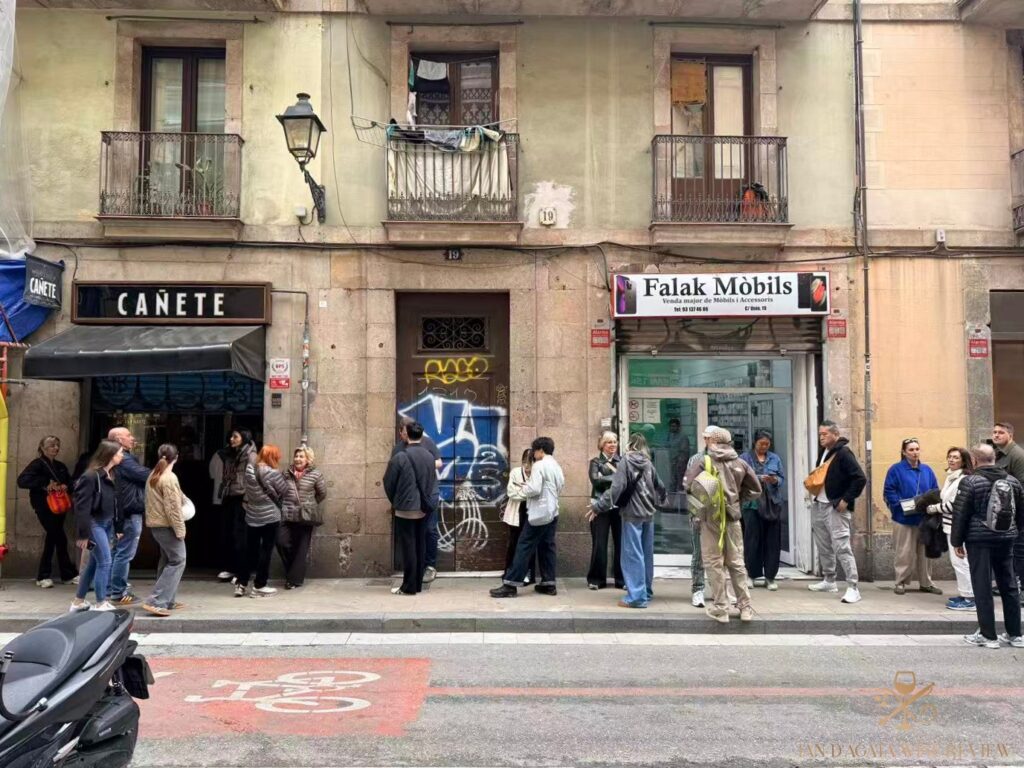
Bar Cañete

Carrer de la Unió, 17

08001 Barcelona, Spain

Tel. +34 933 17 10 95
The dishes

Coca de cristal con tomate

Navajas a la plancha & Anchoas del Cantábrico

Chanquetes fritos & Croquetas de jamón

Bocata de calamares

Filete de vaca vieja con foie y salsa de trufa

Albóndiga melosa de ternera con boletus

Coulant de chocolate

Fresas con nata 

In Barcelona, there are many places where you can eat well, but only a few where time seems to lose its importance. Bar Cañete is one of them.

It sits just off La Rambla, in a location that might make you hesitate at first — the kind of area that usually means crowds, tourists, and the risk of disappointment. But once inside, it quickly becomes clear that this is not that kind of restaurant. There is always a queue at the door, and the room is constantly full. The bar is packed, waiters move quickly between tables, and although it may look chaotic at first glance, everything follows its own rhythm.

It is difficult to define the place and the experience it offers simply. It is not fine dining, but neither is it a casual, forgettable spot. It feels more like a refined version of a traditional tapas bar. The format remains the same — dishes are shared, orders keep coming — but what arrives on the table is noticeably more precise.

The cooking here is straightforward: plancha, frying, olive oil. There is little technical complexity, and the focus remains firmly on the ingredients themselves — especially seafood. Razor clams, anchovies, small fish — often handled minimally, then brought directly to the table. What makes this place particularly interesting is not the ingredients or the technique, but the absence of a fixed order. You eat, and then decide what comes next.

This lunch started at one o’clock and continued until four. No one controlled the pace. Dishes arrived one after another, and the wine kept being refilled. The table quickly became crowded — plates, bread, and glasses overlapping. As soon as one round was cleared, another would take its place. There was no clear beginning or end; it simply kept unfolding. The restaurant remained full the entire time — almost overly so. There was always a line outside, yet inside the atmosphere never felt tense. Instead, it reflected something distinctly Barcelona: relaxed, slightly loud, but deeply comfortable. At some point, you realize that time no longer matters.

The meal begins with the simplest flavors. The Coca de cristal con tomate was what we started with. At first glance, it seems simple: bread, tomato, olive oil, perhaps a touch of salt. But in Catalonia, this is almost always the starting point of a meal. It is less a dish than a way of eating. Here, it is made with coca de cristal, a thinner, crispier bread that is lighter than standard loaves and absorbs the tomato and olive oil more effectively. The preparation is direct — ripe tomatoes are rubbed onto toasted bread, then finished with olive oil. There is no unnecessary intervention, but the quality of ingredients becomes crucial: the bread must have structure, the tomatoes must be fully ripe, and the olive oil must be clean Throughout the meal, it remains on the table. Used with seafood, with fried dishes, even alongside meat later on. It does not try to stand out, but instead acts as a bridge, connecting different stages of the meal so that flavors do not feel interrupted or overwhelming. Similar breads exist in Italy and France, but they are usually served alongside dishes or as part of a specific course — not as a constant presence from beginning to end. Next up was the Navajas a la plancha & Anchoas del Cantábrico. Here, seasoning is minimal — olive oil and a touch of salt. The flavors are clean and direct. Cantabrian anchovies, in particular, are considered a benchmark of quality in Spain; the simpler the preparation, the more they reveal. The Chanquetes fritos & Croquetas de jamón introduce fat and crispness, yet still feel light. The small fish are coated in a very thin batter, resulting in a texture that remains delicate and clean. Interestingly, true chanquetes are now protected in Spain. What is served today are usually similar small fish, yet the name remains. As for croquetas, they are found everywhere in Spain. Originally a way to reuse leftover ingredients, they have become one of the most emblematic bar foods. The Bocata de calamares is one of the restaurant’s signature dishes. In Spain, it is traditionally a classic bar food, most closely associated with Madrid — simple, direct, designed to be eaten quickly, often while standing and talking. The typical version consists of freshly fried squid placed in plain white bread, with little to no seasoning. The focus is not on detail, but on efficiency and satisfaction. Here, the approach is more refined. The bread is lighter, the frying cleaner, and there is no noticeable use of sauces. The result feels less heavy, more balanced — still the same dish, but with a different intention. The Filete de vaca vieja con foie y salsa de trufas inevitably brings to mind British or French references, such as beef Wellington, but here the approach is entirely different. There is no complex technique — instead, several high-intensity elements are layered directly. Vaca vieja refers to older cattle, resulting in deeper, more concentrated flavor. The truffle sauce further amplifies the aromatic intensity, while the foie gras increases the richness. The steak itself is handled with restraint, allowing these elements to define the dish. This is clearly the most powerful moment of the meal. Albóndiga melosa de ternera con boletus is found everywhere in Spain, from home kitchens to small bars. It is simple, not particularly refined, but deeply familiar. Here, it is more nuanced. Melosa refers to a soft, almost creamy texture, while the addition of boletus (porcini) adds depth and complexity.

My desserts were Coulant de chocolate and fresas con nata are both classics. Coulant de chocolate has a cake-like exterior with a molten chocolate center, usually served with vanilla ice cream. The overall profile is rich and concentrated. Fresas con nata is built around fresh strawberries, served with cream and ice cream, sometimes with a touch of citrus zest. It is lighter, with a gentle acidity that keeps it fresh. Together, these two desserts — one richer, one lighter — form a very typical way of closing the meal. In a setting like Cañete, the choice of wine becomes particularly important. Because of the tapas format, dishes arrive continuously, without a fixed order, making it difficult to pair wines with individual plates. Rather than matching wine to a single dish, the goal becomes finding something that can move seamlessly through the entire meal. In this context, heavier red wines tend to feel less suitable. With seafood, fried dishes, and meat alternating throughout the meal, they can easily feel too concentrated and lack flexibility.

For this lunch, I chose a selection of classic Spanish white wines.

The meal began with Gramona Imperial 2019 Corpinnat from a group of producers that have separated from the traditional Cava DO, placing greater emphasis on grape origin and terroir expression. The bubbles are fine, the style clean, and it integrates easily without interfering with flavors. It works naturally with the opening seafood dishes, setting a relaxed tone for the meal. Next came two Albariños.

The first, Attis Lías Finas Albariño 2024, is lighter and more direct in style, with bright acidity and a clean profile. Within the constantly shifting rhythm of the meal, it is the kind of wine that can be enjoyed continuously without fatigue.

The second, Castiñeiro Albariño 2024 (Eulogio Pomares), offers more structure. The influence of lees aging gives it additional texture and depth, making it more than just a refreshing white. It pairs naturally with seafood, while also holding its ground alongside slightly richer dishes. These two wines were ordered together, allowing for a direct comparison — one defined by clarity and lightness, the other by structure and texture.  Finally, Nosso Verdejo 2024 Menade. Compared to the Albariños, it introduces a different profile — more herbal, with a subtle bitterness and a more direct expression. Placed towards the end of the meal, it shifts the rhythm slightly, preventing the palate from remaining in the same register. It works particularly well with fried dishes and meat, where this contrast becomes more apparent.

One last word: The restaurant is almost always full, and reservations are strongly recommended. Enjoy!

The wines in this tasting

Membership Required

You must be a member to access this content.

View Membership Levels

Already a member? Log in here
Share the Post:
Yumi Liu

Yumi Liu has been collecting and drinking wine for more than a decade and has earned a slew of wine certificates in the interim: level 3 WSET and now planning diploma studies; Educator level in Spanish wines (Wines of Spain certified), top level New Zeland wines (Wines of New Zeland certified) and obtained the highest score in her class for German wines (Wines of Germany certified). She has passed all of Ian D’Agata’s Italian wine courses and is generally regarded as being one of the most knowledgeable people on Italian wine in all of China. Over the years, she has also served as the Wine Educator at EMW wines, one of China’s five largest and most important fine wine importers and has led masterclasses on wines at prestigious wine shows including the Wine to Asia fair in Shenzhen and Vinitaly in Verona.

Related Posts

icon

ABOUT THE IAN D’AGATA WINE ACADEMY AND ITS COURSES

Ian’s background in wine teaching and course creation Ian D’Agata has led different wine schools over the years, and has been increasingly asked over the years to set up new ones for different outfits. In the early 2000s, he taught wine courses at the Gambero Rosso’s Citta’ del Gusto, and...

No comments yet.


Show winery reviews

  • Attis
  • Eulogio Pomares
  • Gramona
  • Menade