In the Atlantic Ocean, at the eastern edge of Spain’s Canary Islands, Lanzarote appears less like a traditional wine region and more like a stark landscape shaped by volcanic forces. Between 1730 and 1736, a series of eruptions from the Timanfaya volcano dramatically transformed the island’s geography, covering vast areas of farmland with lava and volcanic ash. For the inhabitants of the time, the disaster seemed to signal the end of agriculture.
Yet it was precisely on this seemingly barren volcanic terrain that local farmers gradually discovered an unexpected possibility. The volcanic fragments covering the soil — locally known as picón or lapilli — possess remarkable porosity, allowing them to absorb and retain moisture from the night air. In an environment with almost no rainfall, this layer of volcanic gravel acts as a natural reservoir, providing vines with the minimal water they require. To protect the vines from the strong winds blowing in from the Atlantic, growers began digging deep pits into the volcanic ash and building semicircular stone walls around each vine. Over time, this distinctive cultivation method came to define the most recognizable vineyard landscape of Lanzarote.
Today, vineyards rooted in this volcanic terroir form one of the most distinctive agricultural landscapes within the Lanzarote Denominacion de Origén (DO). The most famous of these areas is La Geria, where a unique system of volcanic viticulture gradually took shape and continues to this day.
La Geria: A Vineyard Landscape Shaped by Volcanic Ash
La Geria is the most emblematic wine-growing area of Lanzarote: it’s a volcanic valley located in the central part of the island blessed with a striking landscape that is the direct result of the geological legacy left behind by the Timanfaya eruptions of the eighteenth century. Thick layers of volcanic fragments now cover the original soil, forming the black granular material locally known as picón or lapilli. Because of its porous structure, this volcanic layer absorbs moisture from the humid night air and slowly releases it during the day, allowing vines to survive in conditions where rainfall is almost non-existent.
Indeed, Lanzarote’s climate is extremely harsh. The island receives an average annual rainfall of only 100 to 150 millimeters, and in some years even less than 100 millimeters, making it one of the driest wine regions in Europe. Under such conditions, vines cannot rely on rainfall and instead depend largely on the moisture retained in the volcanic gravel and on humidity carried by the Atlantic air.

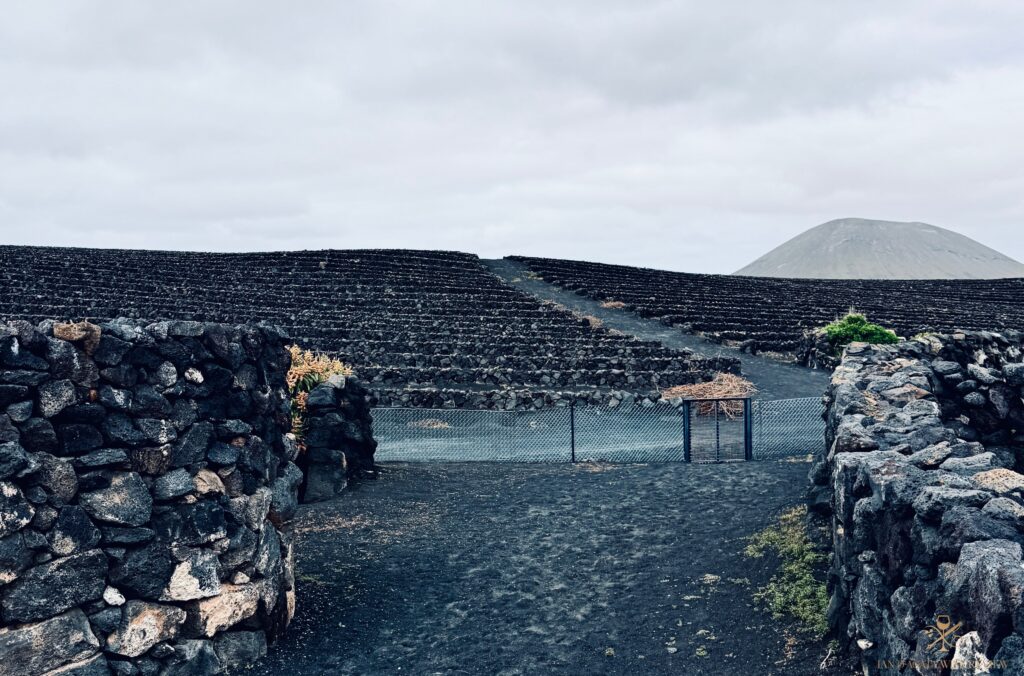
Viticulture in La Geria therefore differs dramatically from that found in most vineyards around the world. Rather than being planted at the surface, vines are grown in hand-dug pits known locally as hoyos. These pits often reach depths of one to two meters, allowing roots to penetrate the volcanic ash layer and reach the soil beneath. Around each vine, growers construct a semicircular stone wall known as a zoco, designed to shield the plant from the powerful northeast trade winds.
Seen from a distance, the vineyards resemble a field of dark volcanic sand scattered with countless circular depressions, each containing a single vine. This extremely low planting density is not only an adaptation to the island’s severe climate, but also one of the defining characteristics of Lanzarote’s agricultural landscape. In La Geria, vineyard density typically ranges from 200 to 400 vines per hectare, far lower than in many traditional European wine regions. In Burgundy or Bordeaux, for instance, densities often reach 4,000 to 8,000 vines per hectare. Clearly, such a dramatic difference reflects not only distinct viticultural traditions, but also a direct response to environmental constraints: in Lanzarote’s volcanic soils and arid climate, each vine requires a larger space to access the limited water and nutrients available.
In terms of scale, Lanzarote is not a large wine region. According to recent statistics from the Lanzarote DO, the appellation includes roughly 1,900 hectares of registered vineyards, cultivated by about 1,800 growers, with approximately twenty wineries operating across the island. This structure results in a highly fragmented viticultural landscape, where many vineyard parcels remain small and are still maintained by family growers. On average, vineyard holdings amount to around one hectare per grower.
At the same time, vineyards represent a remarkably large share of the island’s agricultural land. Recent agricultural data suggest that vineyards account for more than 75 percent of all cultivated land on Lanzarote. In other words, on an island of modest overall size, vines dominate the agricultural landscape. Yet this dominance does not reflect large-scale production. Rather, it is sustained by a mosaic of small, scattered vineyards maintained largely through manual labour.
Old Vines and Own-Rooted Vines
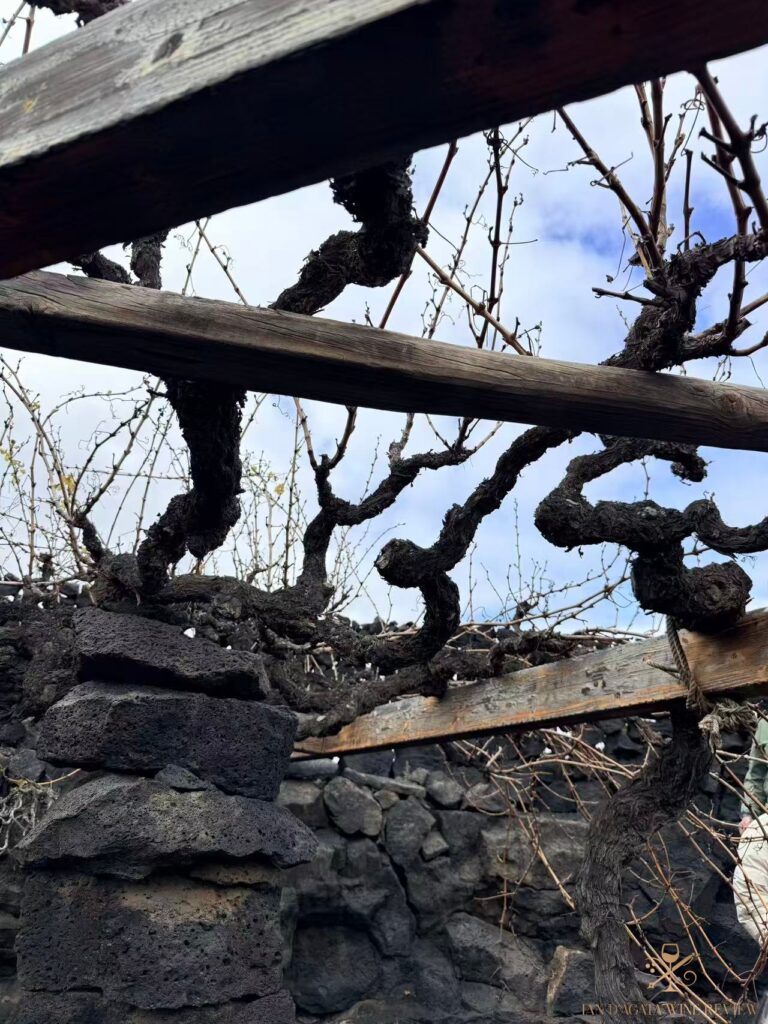
Another important reason for the relatively low yields in La Geria is the age of many of its vines. In numerous vineyards across Lanzarote, vines are several decades old, and some are even older. These mature vines naturally produce smaller crops, but they often yield fruit with greater concentration and balance.
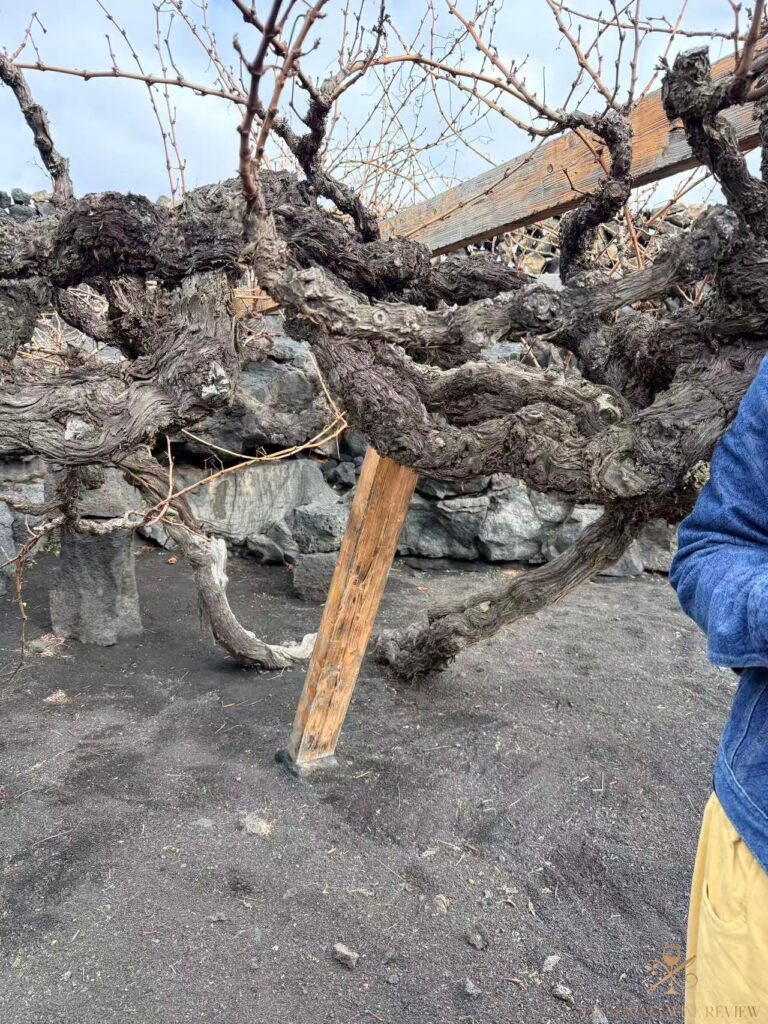
The survival of these old vines is also linked to the fact that parts of the island’s vineyards remain planted on their own roots. Unlike most European vineyards, which were replanted on American rootstocks following the phylloxera crisis of the late nineteenth century, Lanzarote was largely spared from the devastation of this pest thanks to its volcanic sandy soils in which the parasite cannot survive. As a result, some vineyards on the island still preserve the original Vitis vinifera root systems, a rare condition in modern viticulture. This characteristic not only holds historical significance but also forms an integral part of the island’s viticultural identity. For many growers, these old, own-rooted vines represent both an agricultural heritage and a key foundation of Lanzarote’s distinctive wine style.
Malvasía Volcánica
Within Lanzarote’s grape varieties, Malvasía Volcánica undoubtedly occupies a central position. Today it stands as the island’s most representative white grape and forms the basis of many of its wines. Despite the presence of the name Malvasía, the term is better understood in ampelography as referring to a historical Malvasia group rather than a single genetic family given that many so-called ‘Malvasia’ varieties are in fact unrelated. Malvasía Volcánica is generally regarded as a distinct variety within this broader group.
Recent genetic studies suggest that Malvasía Volcánica may have originated from a cross between Malvasía Aromática (also known as Malvasía Dubrovacka) and the local Canary Island variety Bermejuela, also known as Marmajuelo (Zérolo et al., 2006). Nevertheless, its precise genetic background remains a subject of ongoing research.
From a viticultural perspective, Malvasía Volcánica shows remarkable adaptability to Lanzarote’s extreme conditions. Even under severe drought, poor soils and persistent winds, the grape is capable of stable growth. Its roots are able to penetrate the volcanic gravel layer and reach the soil beneath, while the moisture-retaining capacity of the volcanic ash provides a vital source of water. In terms of flavour profile, wines made with Malvasía Volcánica typically display a clear and delicate aromatic structure. Common aromas include citrus, white flowers and ripe stone fruits, often accompanied by subtle mineral and saline nuances — characteristics frequently associated with Lanzarote’s volcanic soils and Atlantic climate.

On the Ground in La Geria
When one finally walks through La Geria, the descriptions found in books and photographs hardly capture the visual impact of the landscape. Vast stretches of black volcanic fragments cover the rolling slopes, as though the land itself had been reshaped by ash. From afar, the vineyards no longer resemble conventional vineyards, but rather a field of volcanic craters scattered across the terrain. Each hollow contains a single vine, while the semicircular stone walls surrounding them resemble miniature fortifications, quietly shielding the plants from the Atlantic trade winds. Standing among these vineyards, what surprises most is not the landscape itself, but the extremity of the environment. Intense sunlight, constant wind and soils that appear almost devoid of water make it difficult to imagine how vines manage to survive here at all. And yet, under these very conditions, many of these vines have endured for decades, sometimes even longer.
The severity of this terroir also explains why Lanzarote wines have never developed into large-scale production. Vineyard yields are inherently limited, and the cultivation system based on hoyos and zocos leaves little possibility for mechanization, requiring intensive manual labour. At the same time, the island’s wine production remains fragmented and small in scale. Many wines are sold primarily within the local market, through tourism or direct winery sales. Combined with the logistical constraints of island transport and the limited production volumes, Lanzarote wines — even when of considerable quality — often struggle to establish a stable presence in broader international markets.
Perhaps for this reason, the most direct way to understand Lanzarote’s wines ultimately returns to the glass itself. By tasting a range of wines made entirely from Malvasía Volcánica, one begins to see more clearly how this volcanic terroir leaves its imprint on aroma, structure and texture.
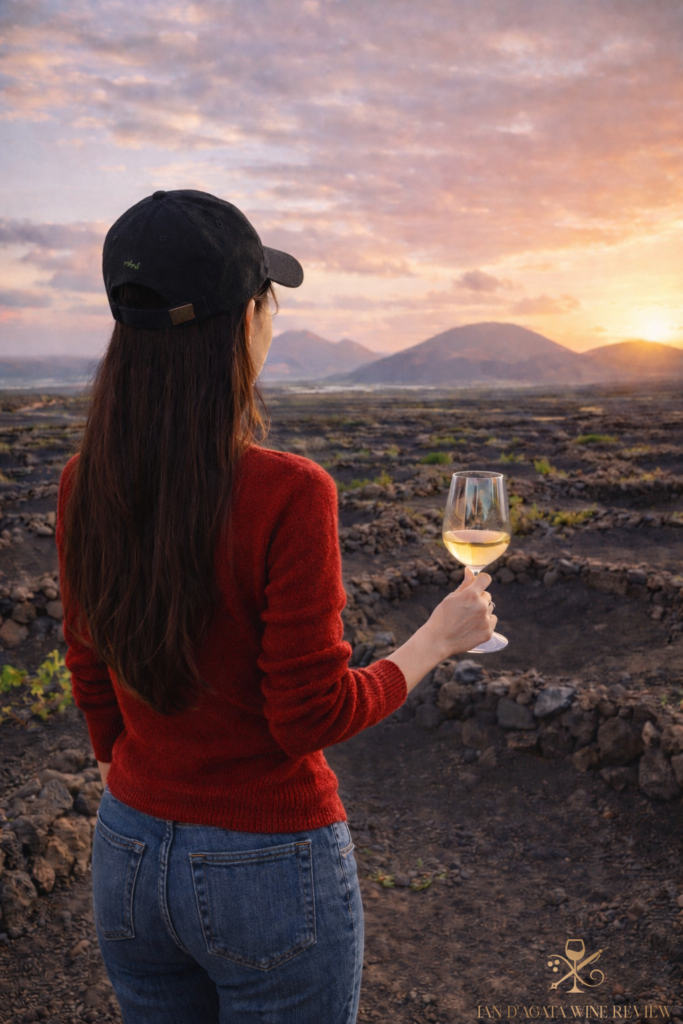
The wines in this tasting report
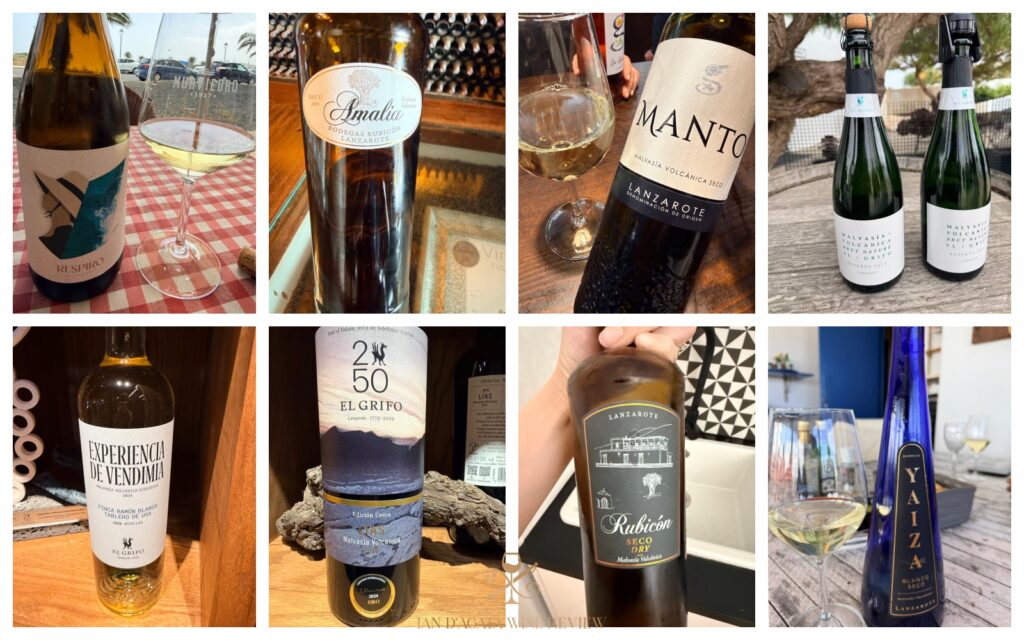
All the wines tasted here are made from 100% Malvasía Volcánica and tasted during my recent trip to Lanzarote and the Canary Islands in March 2026. From simple dry whites to lees-aged expressions and a traditional-method sparkling wine, different vintages and winemaking approaches reveal the many faces this grape can take within the volcanic terroir of Lanzarote.