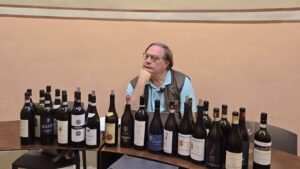
In the historical narrative of Montalcino, Case Basse has never lacked an aura of legend. Yet rather than repeating in this space discussions of philosophy and positioning, I think the more relevant question is whether those narratives are truly reflected in the structure of the wines themselves.
The estate is located in the central-southwestern sector of Montalcino, near Tavernelle in the Santa Restituta sub-subzone of Montalcino, at over 300 meters above sea level. Gianfranco Soldera purchased the property in 1972 and planted the first Sangiovese vines in 1975. From the beginning, the focus remained firmly on the vineyard. Here, quality is understood as the result of ecological stability, careful ripeness assessment, and the integrity of the fruit—not technical embellishment. It follows that all grapes are harvested by hand and subjected to strict bunch-by-bunch and berry-by-berry selection before fermentation. Harvest timing is determined by vintage conditions and fruit maturity rather than by fixed formulas. Control over fruit health and ripeness balance forms the foundation for the wine’s purity and structural precision. Fermentation lasts slightly more than three weeks, followed by approximately firty-four months in large Slavonian oak casks and further bottle aging before release. Oak serves primarily as a means of structural integration rather than flavour imprint. The evolution of flavor derives from grape and vintage more than from winemaking intervention.