
Rare Champagne originated within the historic Piper-Heidsieck house, founded in 1785 in Reims by Florens-Louis Heidsieck. The Piper-Heidsieck Maison’s early prestige is closely linked to its presentation of its Champagne to Queen Marie-Antoinette, an association that remains an established and documented part of Piper-Heidsieck’s heritage.
The modern identity of Rare, however, is not rooted in anecdotal royal preferences, but rather in a long-standing tradition of producing exceptional, vintage-only cuvées. In 1885, to commemorate the centenary of Piper-Heidsieck’s first prestigious bottling, the House released La Cuvée du Centenaire, a limited wine that can be considered the conceptual predecessor of today’s Rare Champagne.
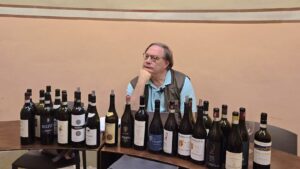
The idea of creating a distinct, ultra-prestige Champagne resurfaced a century later. In 1985, Piper-Heidsieck officially launched the first Rare Champagne, produced from the 1976 vintage, marking the realization of a vision that had remained dormant for decades. The release took place at the Château de Versailles, symbolically acknowledging the historical link between the House and the French court.
Rare Champagne has since been produced exclusively in outstanding vintages, with a deliberately selective release policy. To date, only fourteen vintages have been released (plus one other vintage in which only the rare Rosé was made). The wine follows a consistent stylistic formula of approximately 70% Chardonnay and 30% Pinot Noir, sourced from Grand Cru and Premier Cru vineyards, with an unusually high proportion of Chardonnay by Champagne standards—particularly significant given the difficulty of sourcing Chardonnay from areas such as the Montagne de Reims.
Extended ageing is a defining element of Rare’s style, with the wines typically spending around ten years on the lees before release. Importantly, vintages are not released sequentially, but rather according to their individual evolution and readiness, reflecting the House’s emphasis on quality over chronology.
Originally positioned as the prestige cuvée of Piper-Heidsieck, Rare became an independent Maison in 2018, under the direction of Christian Descours, allowing the brand to fully assert its singular identity within Champagne. Today, Rare is recognized not only for its vintage Champagne Brut, but also for producing one of the region’s most compelling Rosé Champagnes, despite its Chardonnay-driven profile.
Understanding Rare’s Slow-Burning Nature through Terroir and Craft
Rare’s winemaking philosophy must be understood first through its approach to raw material and terroir, rather than solely through cellar practices. Although the Montagne de Reims is traditionally associated with Pinot Noir, Rare sources part of its Chardonnay from this area—a choice that is, in itself, unconventional. Compared with Chardonnay from more classic Champagne growing zones, these sites tend to emphasize acid stability and structural tension rather than aromatic generosity, laying the groundwork for long-term evolution.
On this foundation, Rare has developed a Chardonnay-driven structural framework. The high proportion of Chardonnay (around 70%) defines the wine’s overall profile: linear, compact, restrained, and profoundly reliant on time. Pinot Noir plays a clearly defined supporting role, contributing breadth and vinosity to the mid-palate rather than immediate richness or dominance. This balance alone indicates that Rare is not conceived as a Champagne for early consumption.
In the cellar, Rare does not rely on overt technical signatures or stylistic markers. Rather than putting an emphasis on cellar-driven flavours, winemaking choices consistently prioritize clarity, tension, and long-term balance from the base-wine stage onward. Fermentation and ageing decisions are made to preserve structural precision and acid integrity, rather than to pursue early roundness or expressive appeal.
Extended lees ageing is a crucial component of Rare’s identity, yet its purpose is not to amplify overt autolytic or yeasty character. Even after more than a decade on lees, Rare rarely displays dominant autolytic notes; instead, fruit expression remains precise, focused, and tensile. This suggests that lees ageing functions primarily to stabilize structure, integrate texture, and protect aromatic purity, rather than to replace fruit with yeast-derived flavours.
This approach is clearly reflected in tasting. I first tasted the newly released 2013 vintage at the Rare estate last year and revisited it again this year. While subtle evolution was evident, the wine remained notably reserved: aromatic development was limited, and the structure continued to feel compact and inward-looking rather than expansive. Change was perceptible, but restrained—confirming that even after extended lees ageing, Rare is often released at an early stage of its life.

Release, therefore, does not equate to full expression. In Rare’s philosophy, release signals structural completion and long-term stability, while aromatic openness and complexity are intentionally deferred to bottle ageing. Time is not treated as a passive afterthought, but as an integral design variable—one that informs terroir selection, winemaking choices, and release strategy alike. This integrated view of time underpins Rare’s consistency of style and explains why its wines are never designed for immediate gratification, though they can certainly be enjoyed young if one so wishes, given how delicious they are from the get-go.
Vintage as the Outcome of Time Management and Selection
Rare’s vintage history offers perhaps the clearest insight into its philosophy. Since the inaugural 1976 vintage, only fifteen vintages (if you add the Rosé that was the only Rare Champagne made in 2014, so fourteen plus one) have been released over nearly half a century. This exceptionally low frequency reflects not a strategy of manufactured rarity, but the cumulative result of long-term judgement and repeated restraint. Within Rare’s framework, vintage is not merely a climatic record, but part of a longer temporal equation. As previously discussed, release does not mark stylistic completion, but rather structural readiness for extended ageing. Differences between vintages therefore manifest less in immediate expressiveness than in their respective rhythms of evolution and modes of tension.
The recently released 2015 vintage remains firmly in its early phase. Youthful and compact in the glass, its aromatic profile is still tightly contained, and its overall shape remains incomplete. This condition is entirely consistent with Rare’s established release logic: wines are released once structure is secured, not once expression has fully unfolded. The fuller articulation of the vintage is intentionally entrusted to time in bottle.

The wines in this vertical tasting report
