Ponja Nikkei in Madrid: Where Peru Meets Japan, and Acidity Meets Umami

by Yumi Liu

Ponja Nikkei

Calle de Sta. Teresa 16

28004 Madrid

Spain

Tel. +34 914 45 69 45

The Dishes

Hamachi, eel and Leche de Tigre (Cebiche Ponja de Hamachi y Anguila)

Hamachi with Ají Amarillo sauce (Tiradito de Hamachi al Ají Amarillo)

Gyozas filled with European spider crab and red prawns (Gyozas de Centollo y Gambón)

Gyozas filled with pork and mushrooms (Gyozas Mar y Tierra)

Steamed bao with crispy soft-shell crab (Bao de Cangrejo de Concha Blanda)

Japanese A5 Wagyu grilled in a Josper charcoal oven (Wagyu A5 al Josper)

Concolón rice with Norway lobster (Arroz Concolón de Cigala)
If this is your first visit to a Nikkei restaurant, many of the names on the menu may seem unfamiliar. Cebiche, Tiradito, Leche de Tigre, Ají Amarillo, Concolón—none of these belong to traditional Japanese cuisine, nor are they dishes that, for the most part, most people readily associate with Peru. In fact, Nikkei has evolved into a distinct culinary tradition of its own, and Ponja has become one of Madrid’s most compelling ambassadors of this cuisine.

In fact, even the restaurant’s name tells the story. The name Ponja is derived from two words. Pon refers to Ponzu, one of the most iconic sauces in Japanese cuisine, while Ja comes from Ají, the defining ingredient of Peruvian cooking. Rather than inventing an attractive brand name, the restaurant chose to combine two ingredients that best represent the culinary identities of Japan and Peru. It is not merely a name, but a statement of intent.

To understand Ponja, one must first understand Nikkei Cuisine. In the late nineteenth century, Japanese immigrants arrived in Peru and, unable to access the ingredients they had known at home, began adapting Japanese techniques to local seafood, citrus fruits and Ají peppers. Over more than a century, this culinary exchange gradually evolved into what is now recognised as Nikkei cuisine—a gastronomic tradition with its own history, philosophy and culinary logic, rather than simply another form of fusion cooking. And if Peru gave birth to Nikkei cuisine, Madrid has emerged as one of its most dynamic homes in Europe. Outstanding seafood, strong cultural ties with Latin America and a new generation of innovative chefs have all contributed to the city’s thriving Nikkei dining scene, with Ponja standing among its most accomplished representatives.

With this context in mind, Ponja’s menu immediately becomes far more meaningful.

Rather than simply placing Japanese and Peruvian dishes side by side, it presents a carefully choreographed culinary journey. Each course builds naturally upon the previous one, with acidity, umami, texture and temperature constantly evolving while remaining anchored by a single underlying idea, that of acidity and umami. Together, they form the central thread running through the entire menu and define Ponja’s culinary identity.

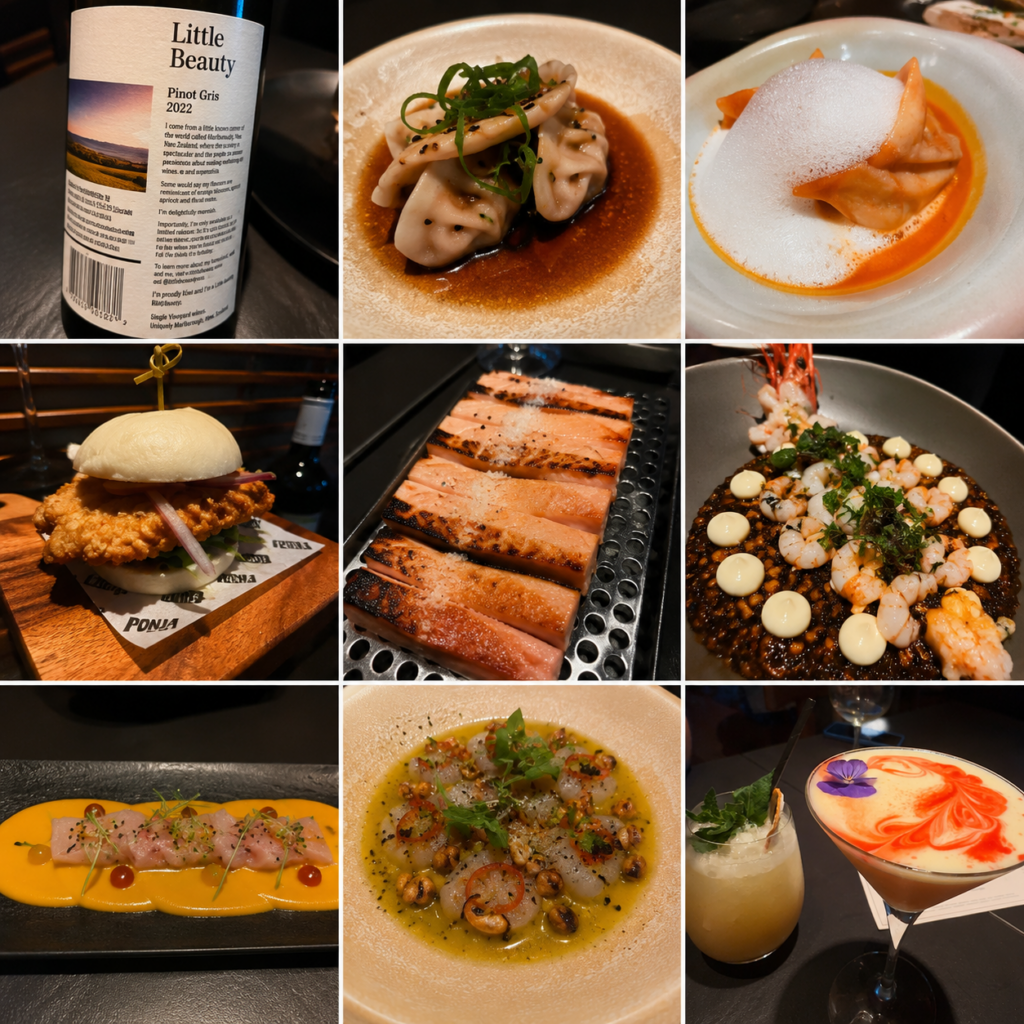
If there is one dish that best captures Ponja’s philosophy, it is undoubtedly the restaurant’s signature Cebiche Ponja. For many diners, Cebiche (or Ceviche) requires little introduction. Peru’s national dish is traditionally prepared with lean white fish such as Corvina (sea bass), dressed with Leche de Tigre—the classic marinade made from lime juice, fish stock, onion, coriander and Ají peppers—which gives the dish its vibrant acidity. Ponja, however, takes a different approach. Instead of Corvina, the kitchen chooses Hamachi (Japanese amberjack). This is not innovation for innovation’s sake, but a thoughtful decision. Hamachi’s richer texture and finer layer of fat allow it to better withstand the bright acidity of the Leche de Tigre while preserving the fish’s natural sweetness and achieving a more harmonious balance. The restaurant also incorporates eel, introducing a delicate smoky note and an additional layer of savoury depth without ever overshadowing the elegance of the Hamachi. As the opening course of the evening, it did exactly what it was meant to do: awaken the palate while establishing the flavour profile that would define the rest of the meal.

If Cebiche represents the Peruvian side of Nikkei cuisine, Tiradito more clearly reveals its Japanese heritage. At first glance, the two dishes appear remarkably similar. Both are built around raw fish, yet their culinary logic is fundamentally different. Where Cebiche relies on Leche de Tigre to briefly “cook” the fish through acidity, Tiradito is much closer to Japanese sashimi. The fish is sliced thinly and the sauce is gently spooned over immediately before serving, allowing the natural texture of the fish to remain almost entirely intact. Here again, Ponja chose Hamachi, but this time the true protagonist was Ají Amarillo. For many diners unfamiliar with Peruvian cuisine, Ají Amarillo is often mistaken for simply another chilli pepper. In reality, its importance lies not in its heat, but in its remarkably expressive aromatics, combining notes of ripe yellow fruit, citrus peel, delicate flowers and subtle herbs. It is precisely this distinctive aromatic profile that has made it one of the defining ingredients of modern Peruvian cooking.

After two raw fish courses, the menu naturally shifted towards warm dishes. The first to arrive were two varieties of Gyoza. Although originally derived from the Chinese dumpling, Gyoza has long become one of Japan’s most iconic everyday dishes, making it a natural addition to contemporary Nikkei cuisine. Gyozas de Centollo y Gambón continued the menu’s emphasis on seafood. Filled with European spider crab (Centollo) and red prawns, the dumplings relied on the natural sweetness of the shellfish rather than elaborate seasoning, allowing the purity of the ingredients to take centre stage. The Gyozas Mar y Tierra, however, took the meal in a completely different direction. Given the pork and mushroom filling, I expected a richer, heavier dish. Instead, what struck me most was its remarkably vivid acidity. It cut cleanly through the richness of the pork while simultaneously sharpening the savoury character of the mushrooms.

The Soft Shell Crab Bao also deserves mention. Strictly speaking, Bao does not belong to traditional Nikkei cuisine. Originating in China and later becoming deeply rooted in Taiwanese food culture, it has nevertheless found a natural place on many contemporary Nikkei menus as the cuisine continues to evolve and embrace broader Pan-Pacific influences. Ponja’s version was straightforward but well executed. The crisp soft-shell crab contrasted beautifully with the pillowy steamed bun, while the sauce maintained the restaurant’s characteristic balance of freshness and savoury depth without ever becoming excessive.

The main courses marked the final chapter of the meal. The first main course was Wagyu A5 al Josper. The Josper, a charcoal oven widely used in Spain’s leading restaurants, combines intense heat with gentle smokiness, making it particularly well suited to premium beef. Ponja chose Japanese A5 Wagyu, cooked with impressive precision. The marbling melted evenly throughout the meat, producing an almost buttery texture, while the charcoal added a restrained layer of smoky complexity. Yet for all its technical competence, the dish felt unexpectedly conservative. There was nothing objectively wrong with it, but neither did it express the individuality that had characterised the earlier courses. With beef of this quality, excellence is almost expected. What ultimately distinguishes a memorable dish is not simply the ingredient itself, but the restaurant’s interpretation of it. Fortunately, that impression did not last for long. The Arroz Concolón de Cigala not only restored the momentum of the meal, but also proved to be its undisputed highlight. For those encountering it for the first time, Concolón refers to the prized crispy layer of rice that forms at the bottom of the pan during cooking. In Peru it is considered the finest part of the dish, while in Spain it immediately recalls the Socarrat of a well-made paella. Similar in technique, the two nevertheless belong to different culinary traditions. Here, Ponja builds the dish around Cigala (Norway lobster). A deeply flavoured shellfish stock permeates every grain of rice, combining with the delicate sweetness of the lobster to create remarkable savoury depth. What makes the dish memorable, however, is not simply the crisp Concolón itself, but the remarkable balance between toasted aromas, texture and umami. The lightly caramelised rice adds subtle roasted notes, while the constant contrast between crisp and tender grains keeps every mouthful engaging. Richly savoury without ever becoming heavy, it is a beautifully judged composition. If Cebiche Ponja demonstrates how Nikkei cuisine uses acidity, Arroz Concolón de Cigala shows just how profoundly it can express umami. If I could recommend only one dish at Ponja, this would unquestionably be it. It may not be the most technically elaborate item on the menu, but it is undoubtedly the one that best captures the restaurant’s culinary philosophy.

Ponja’s philosophy extends naturally from the plate to the glass. Before dinner we chose two cocktails, each reflecting one of the two cultures that define Nikkei cuisine. The Yuzu cocktail, inspired by Japan’s iconic citrus fruit, delivered vibrant acidity alongside delicate citrus oils, immediately establishing the freshness that would characterise much of the meal. By contrast, Lúcuma, one of Peru’s most emblematic fruits, offered a softer and rounder expression, bringing warmth and gentle sweetness that beautifully complemented the sharper profile of the Yuzu. Although we eventually paired the meal with the 2022 Little Beauty Pinot Gris Marlborough from New Zealand, the wine has already been reviewed in our Weekly Wine column and therefore requires no further discussion here. More noteworthy was Ponja’s thoughtful wine list, whose emphasis on freshness and minerality makes it particularly well suited to Nikkei cuisine. Wines such as Albariño, Godello, Txakoli, Chablis and Blanc de Blancs Champagne all seem natural companions to the restaurant’s seafood-driven menu and its finely judged balance of acidity and umami.

Share the Post:

Related Posts

icon

ABOUT THE IAN D’AGATA WINE ACADEMY AND ITS COURSES

Ian’s background in wine teaching and course creation Ian D’Agata has led different wine schools over the years, and has been increasingly asked over the years to set up new ones for different outfits. In the early 2000s, he taught wine courses at the Gambero Rosso’s Citta’ del Gusto, and...

No comments yet.


Show winery reviews