Several years ago, when I first stood in the Kastelaz vineyard overlooking the village of Tramin in Alto Adige, what struck me most was not its reputation as one of the world’s great Gewürztraminer sites, but the sheer difficulty of cultivating vines there.
Terraced vineyards climb steeply up the hillside, with the village of Tramin below and the Alps forming a dramatic backdrop in the distance. Situated at elevations between 330 and 380 meters, the vineyard reaches gradients of up to 63 percent. Much of the site is impossible to mechanize. From pruning and canopy management to harvest, nearly every task must be performed by hand. This is heroic viticulture in the truest sense of the term. Yet it is precisely under these extreme conditions that Kastelaz has become one of the most celebrated single vineyards for Gewürztraminer anywhere in the world.

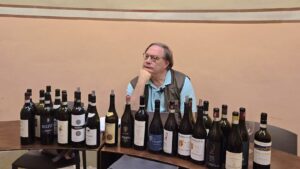
Earlier this year at VINO100 Shanghai, a remarkably rare Kastelaz Gewürztraminer vertical tasting was presented, featuring the 2024, 2023, 2021, 2017, 2016, and 2012 vintages. The latter three were all Argentum Bonum releases (“library releases”) wines seldom encountered even by devoted followers of the estate. For any single-vineyard wine, the opportunity to observe fourteen years of evolution within a single tasting is exceptionally rare. And even more so with Gewürztraminer, that is wine generally not thought of in terms of ageworthiness when in fact the wines age magnificently well.
For me, the most compelling aspect of the tasting was not the comparison of individual vintages, but a more fundamental question: as time passes, does a great Gewürztraminer become increasingly expressive of the variety, or increasingly expressive of the land from which it originates?
From Architect to Pioneer of Alto Adige Wine
Today, Elena Walch is widely known as the “Queen of Gewürztraminer.” Or perhaps, the” Queen of Alto Adige wine’. Yet until the age of thirty-five, wine played virtually no role in her life or at best, a small one.
Trained as an architect, with university studied in Venice and cme back to work in her chosen field in Bolzano. There she entered the Walch family and began questioning many of the traditional viticultural and winemaking practices of the region. Over time, she introduced a series of forward-thinking changes that would prove transformative: reassessing the suitability of grape varieties to specific vineyard sites, replacing the traditional pergola training system with Guyot pruning, and placing vineyard expression—not cellar technique—at the center of quality. Within this framework, Kastelaz gradually emerged as one of the estate’s most important vineyard holdings.

Kastelaz: How Terroir Shapes Great Gewürztraminer
Kastelaz lies above the village of Tramin (from where the variety takes part of its name: traminer, or “of Tramin”) and is one of the relatively few south-facing vineyard sites in Alto Adige.
The soils consist of limestone-rich chalk, sandy components, and humus-rich material scattered with stones. The sandy soils contribute aromatic openness and floral intensity; clay and organic matter provide texture and volume; while limestone delivers the critical acidity, tension, and mineral backbone that define the wine’s structure. For this reason, Kastelaz has never been merely a story of lychee and roses. It possesses aromatics, certainly, but also structure, tension, real power and size, and remarkable aging potential. In its youth, the wine readily displays the floral and spicy characteristics that define Gewürztraminer. With time, however, the structure and minerality underpinning those aromas become increasingly apparent. Gradually, terroir begins to surpass variety as the wine’s dominant form of expression.
Gewürztraminer and the Chinese Table: From Aromatics to Time
This masterclass also prompted me to revisit a question that has long been debated: what kinds of Chinese cuisine pair best with Gewürztraminer? Within Western wine pairing traditions, Gewürztraminer is frequently associated with spicy food. Yet this explanation is often overly simplistic. Spice alone is rarely what determines the success of a pairing. For young, dry, high-quality Gewürztraminer, where floral and spice-driven aromatics dominate, the more relevant consideration is often the interaction between aromatic structures. Gewürztraminer’s hallmark notes of rose petals, lychee, citrus blossom, and exotic spices derive largely from its abundance of terpene compounds. These molecules not only define the variety’s aromatic identity but also create natural affinities with many Asian herbs and spices. In practice, I have found young vintages of Kastelaz particularly compelling alongside ingredients such as ginger, scallions, cilantro, and Thai basil. The wine’s floral and spice-driven aromatics do not overwhelm these ingredients; instead, they amplify one another, creating a heightened sense of harmony between food and wine.

This phenomenon is especially evident in Southeast Asian-inspired dishes and in many cuisines of southern China that rely heavily on fresh herbs, ginger, scallions, and aromatic seasonings. Rather than pairing naturally with a particular regional cuisine, Gewürztraminer seems most successful with dishes whose flavor architecture is built around aromatic plants and fresh spices.
The complexity of Chinese cuisine rarely stems from a single flavor element. A dish may be defined by chili peppers, but equally by herbs, fermented condiments, oils, umami compounds, and cooking technique. As a result, categorizing pairings solely according to spice level—or by regional cuisine—often fails to explain why certain combinations work while others do not. Interestingly, this pairing logic evolves with age.
In the 2017, 2016, and especially the 2012 Argentum Bonum bottlings, the rose, lychee, and citrus blossom notes gradually retreat. In their place emerge beeswax, dried flowers, white truffle, flint, smoke, and increasingly complex mineral nuances. At this stage, Kastelaz is no longer a wine defined primarily by aromatics. It becomes a mature white wine whose identity rests upon structure, complexity, and terroir.
If young Kastelaz naturally gravitates toward aromatic herbs such as ginger, scallions, cilantro, and Thai basil, mature Kastelaz seems better suited to mushrooms, truffles, and dishes built around layers of umami. Time changes not only the wine itself, but also its relationship with the table.
This, perhaps, was one of the most fascinating observations of the entire vertical tasting. Over a span of fourteen years, what evolved was not merely aroma and flavor, but the wine’s place within a gastronomic context.
More importantly, it redefined my understanding of Gewürztraminer.

Young Kastelaz undoubtedly showcases the most captivating aspects of the variety: exuberant floral aromatics, vivid spice notes, and the abundance of terpene-derived compounds that give Gewürztraminer its unmistakable identity. Yet with time, these immediately appealing varietal characteristics gradually recede, allowing a deeper and more profound expression to emerge. In the 2017 and 2016 vintages, and especially in the 2012 Argentum Bonum, what dominates is no longer rose petals and lychee, but minerality, flint, beeswax, white truffle, and a sense of spatial depth that is difficult to describe yet unmistakable in the glass. At this stage, Gewürztraminer is no longer merely an aromatic grape variety. It becomes a vehicle for terroir.
When a wine is capable of retaining both tension and identity over more than a decade, attention inevitably shifts away from the variety itself and toward the land that gave birth to it. The greatest wines ultimately arrive at the same destination. They may begin with a grape variety, but they end with terroir.
The following tasting notes trace Kastelaz’s evolution from youthful aromatic expression to a mature, terroir-driven wine.
The wines in this tasting
All the wines in this tasting were tasted this past May at Ian D’Agata’s VINO100, China’s premier wine show devoted to quality Italian wines. The older wines were part of a vertical tasting masterclass led by Ian D’Agata in which he addressed what makes Gewürztraminer and Kastelaz in particular such an amazing grape and wine.