In the historical narrative of Montalcino, Case Basse has never lacked an aura of legend. Yet rather than repeating in this space discussions of philosophy and positioning, I think the more relevant question is whether those narratives are truly reflected in the structure of the wines themselves.
The estate is located in the central-southwestern sector of Montalcino, near Tavernelle in the Santa Restituta sub-subzone of Montalcino, at over 300 meters above sea level. Gianfranco Soldera purchased the property in 1972 and planted the first Sangiovese vines in 1975. From the beginning, the focus remained firmly on the vineyard. Here, quality is understood as the result of ecological stability, careful ripeness assessment, and the integrity of the fruit—not technical embellishment. It follows that all grapes are harvested by hand and subjected to strict bunch-by-bunch and berry-by-berry selection before fermentation. Harvest timing is determined by vintage conditions and fruit maturity rather than by fixed formulas. Control over fruit health and ripeness balance forms the foundation for the wine’s purity and structural precision. Fermentation lasts slightly more than three weeks, followed by approximately firty-four months in large Slavonian oak casks and further bottle aging before release. Oak serves primarily as a means of structural integration rather than flavour imprint. The evolution of flavor derives from grape and vintage more than from winemaking intervention.
The estate comprises roughly eight hectares, producing typically around 15,000 bottles per year, with significantly lower yields in difficult vintages. Yield control is not presented as rhetoric, yet it is evident in the wine’s concentration and structural coherence.
Ultimately, however, all context must return to the glass.
Soldera’s wines present not power, but proportion. Acidity is linear and persistent, providing steady mid-palate support. Tannins are fine and progressive, restrained in youth yet unfolding with time. Fruit expression is measured rather than opulent, relying on purity and tension rather than sweetness or weight.
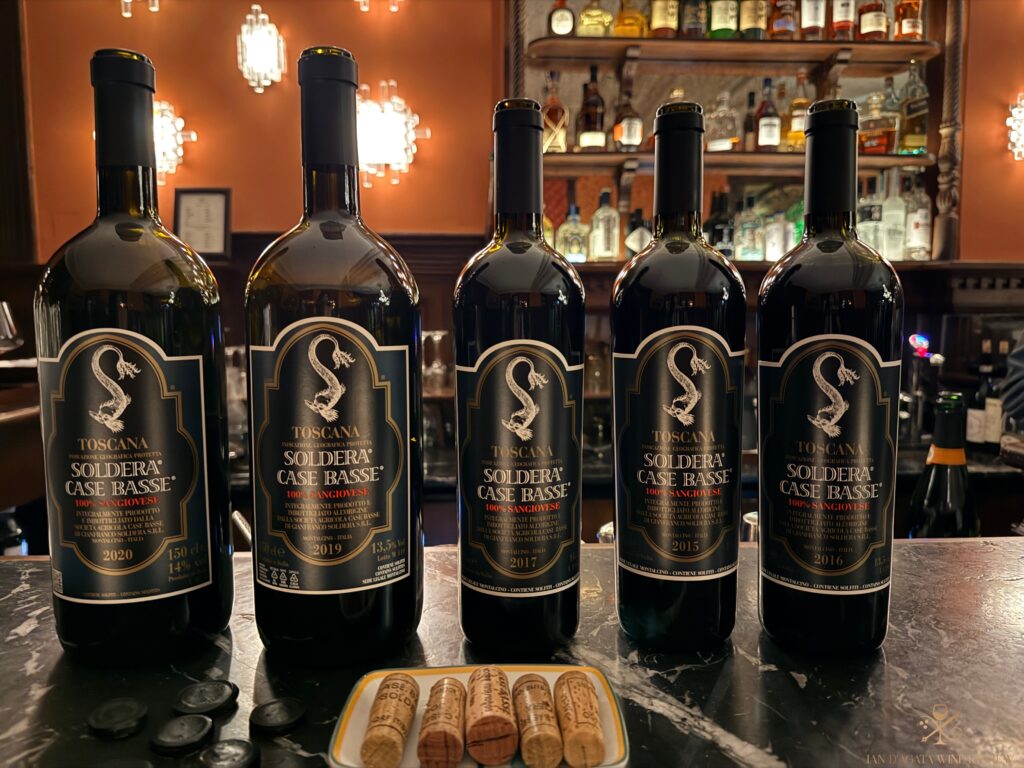
For this vertical tasting report, I sampled the vintages from 2015 to 2020, save for the 2018. Across the five vintages tasted, one visual consistency stands out: with the exception of 2017, which appears slightly deeper and more concentrated, the wines maintain a bright, clear red-ruby color, underscoring their slow evolution and cautioning against assumptions based solely on age. The real differences emerge in aromatic development and structural line.
Viewed from this vertical tasting perspective, what I can conclude is that these five vintages resist simple hierarchy. Instead, they read as variations on a consistent structural language shaped by differing climatic conditions. Warm years offer broader ripeness; classic years emphasize proportion; hot years test structural discipline; larger formats extend the time axis. The essence of Case Basse does not lie in vintage grandeur but in the coherence of its structural logic—linear acidity, fine-grained tannins, and restrained fruit expression. Time is not an accessory; it is the condition through which this structure fulfills itself. In a mature and diverse appellation, Case Basse is not oppositional. It simply moves at a slower pace. And that pace defines its voice.
The wines in this tasting